What "carriage house" actually means (and why it suits San Diego homes)
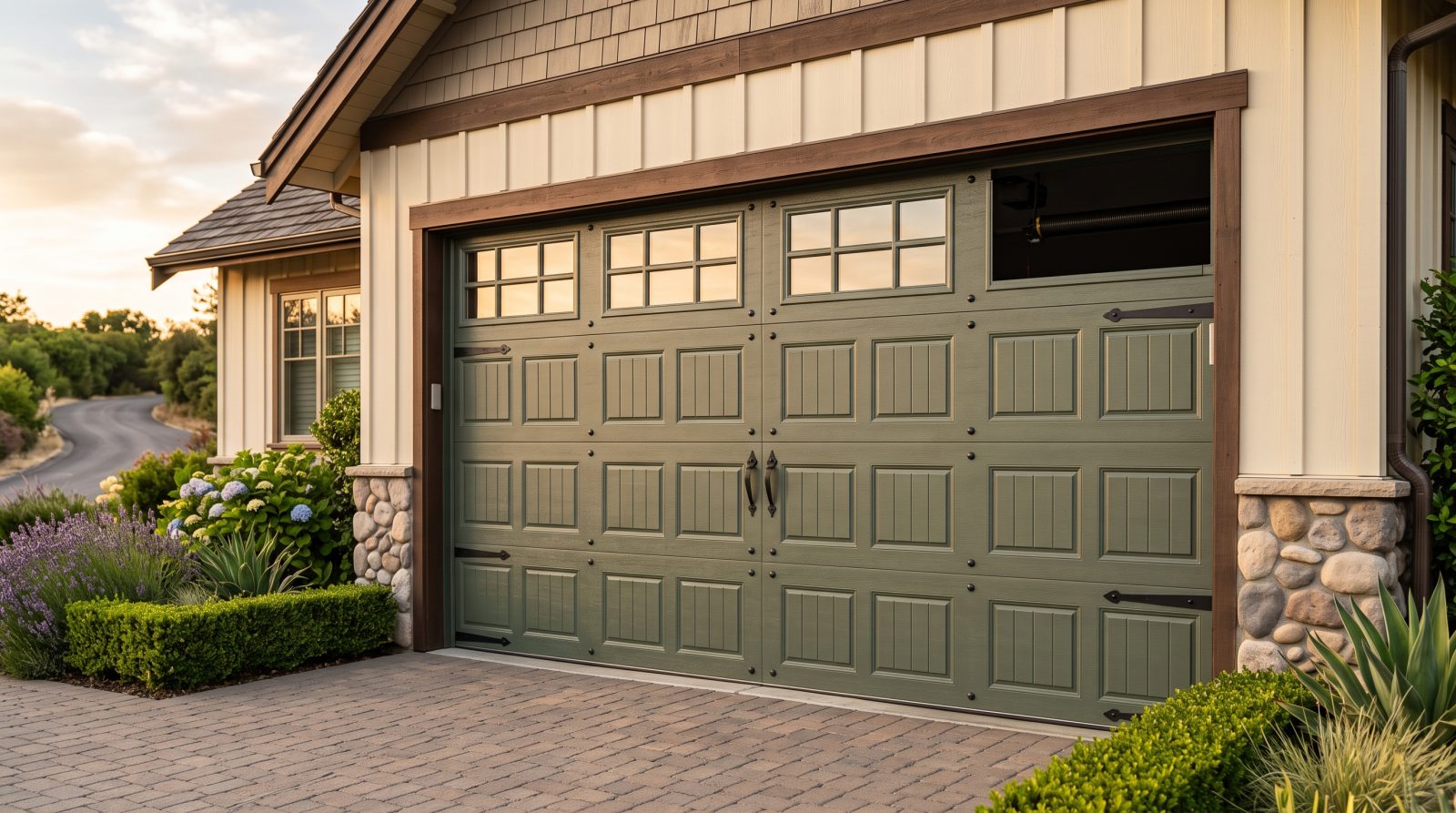
The term "carriage house" comes from the detached buildings that once stored horse-drawn carriages, with tall doors that swung open on hinges. The look is defined by vertical or symmetrical panel divisions, often with decorative hardware like strap hinges and handles, and frequently a row of windows across the top. It reads as handcrafted and traditional rather than flat and utilitarian, which is exactly why it has become a popular upgrade for character-rich neighborhoods.
What surprises most homeowners is that the overwhelming majority of carriage house doors sold today are not true swing-out doors at all. They are standard sectional doors, four or five horizontal panels that roll up on an overhead track, that have simply been styled to mimic the divided look and dressed with carriage-style hardware. You get the curb appeal of a barn door with the day-to-day convenience of a modern opener, no clearance lost in the driveway, no doors to manually swing in a tight setback.
In San Diego, that styling earns its keep. So much of our housing stock, the Spanish Revival and Mission homes, the bungalows of South Park and Normal Heights, the cottages near the coast, was designed in an era before the two-car garage dominated the streetscape. A carriage house door bridges that gap, letting a modern garage sit comfortably under older, more detailed architecture instead of fighting it.
- Two builds exist: "carriage-style" sectional doors that roll up overhead (most common), and true side-hinged or swing-out doors (rarer, niche)
- The look is created by vertical panel divisions, optional decorative hardware, and often a row of top windows
- Pairs naturally with Spanish, Craftsman, Tudor, cottage, and ranch homes common across San Diego
- Keeps full driveway depth and works with any standard opener and remote — no manual swinging
Materials that make sense in a coastal climate
The material you choose matters more in San Diego than in most of the country, because our marine air is mild on temperature but tough on finishes. Salt-laden coastal moisture in beach communities like La Jolla, Pacific Beach, and Coronado can accelerate rust on exposed steel hardware and lift paint on lower-grade doors, while inland heat in El Cajon, Santee, and Poway puts more thermal stress on dark-painted surfaces. The right material is the one that handles your specific microclimate, which is part of why seeing the door against your actual house matters.
Steel carriage doors are popular for good reason: a quality insulated steel door with a baked-on or composite-overlay finish resists denting, holds color well, and carries a faux-wood grain that reads convincingly from the street at a fraction of real wood's cost and upkeep. Faux-wood composite and fiberglass-faced doors take the realism further, mimicking stained timber without the warping, swelling, or repainting that real wood demands, an advantage that grows the closer you live to the water. Genuine wood carriage doors deliver unmatched depth and authenticity for a period home, but they are the highest-maintenance option, especially in coastal humidity, and need periodic refinishing to stay beautiful.
Insulation is worth a serious look if your garage is attached, used as a gym or workshop, or shares a wall with living space. An insulated door (measured by R-value) holds temperature better and runs noticeably quieter, a real benefit in the many San Diego homes where the garage sits directly under or beside a bedroom.
- Insulated steel: strong all-around value, dent-resistant, holds color, convincing faux-wood overlays
- Composite / fiberglass: most realistic wood look with the least upkeep — strong choice near the coast
- Real wood: the most authentic for a period home, but the highest maintenance in marine air
- Ask about corrosion-resistant hardware and finishes if you live within a few miles of the ocean
- Choose an insulated door for attached garages, garages under bedrooms, or workshop/gym conversions
Design choices: hardware, windows, and matching your home
A carriage house door is really a set of decisions, and getting them right is what separates a tasteful upgrade from a door that looks like it was ordered from a catalog without seeing the house. The panel layout sets the foundation: clean recessed panels lean modern-traditional, while heavier raised panels and arched top sections feel more old-world. From there, the decorative hardware, the strap hinges, spade handles, and clavos (decorative bolt heads), defines the personality. Used with restraint it suggests a true swing door; overdone it can look fussy.
Windows are the other big lever. A top row of glass can transform a flat garage wall into an inviting facade and let daylight into the garage, and the glass style should echo the house, clear or frosted, plain or with grilles, square or arched. The finish color is the final move. Many San Diego homeowners go for a warm stained-wood tone to play off stucco and terracotta, a crisp white for cottage and coastal looks, or a deep charcoal or black for a more contemporary contrast against light walls.
Because we are mobile, we work through these choices at your curb, holding samples against your stucco, trim, and front door in the actual San Diego light rather than under showroom bulbs. That on-site comparison is a reliable way to land on a combination that looks intentional and lifts the whole exterior, not just the garage.
- Panel style sets the tone: recessed reads modern-traditional, raised/arched reads old-world
- Decorative hardware (strap hinges, handles, clavos) adds authenticity — best used with restraint
- A top row of windows adds light and curb appeal; match the glass and grille style to your home
- Popular San Diego finishes: warm wood tones with stucco, white for coastal/cottage, charcoal/black for contrast
- We bring samples to your driveway so you can judge color and style in real daylight, against your real facade
How a mobile carriage door install works — and what it costs
Because we come to you, the process is built around your driveway, not a store. It starts with an on-site visit where we measure the rough opening, headroom, and side room, confirm the new door clears your tracks and opener, and review style, material, window, and hardware options against your home. From there you get a clear, itemized quote, and once you approve, we schedule the install and bring everything needed to remove the old door and fit the new one. Many standard jobs are completed in a single visit.
Replacing a carriage house door is more involved than a simple panel swap. A heavier insulated or wood-look door often needs the spring system rebalanced so the door lifts smoothly and the opener is not overworked, and an older opener may need a compatible replacement to handle the added weight safely. Doing this correctly is what protects the door's lifespan and keeps it quiet, so it is worth using an installer who checks the whole system rather than just hanging panels.
On cost, carriage house doors typically sit at the premium end of the residential range because of the styling, overlays, hardware, and windows, with real-wood and fully custom builds at the top. As an industry range, expect a meaningful step up from a plain steel door, with the final figure driven by size (single vs. double), material, insulation, glass, and hardware. We give you a written, itemized quote up front so the number reflects your actual door and opening, not a generic estimate. Request a free quote and we will come measure and price it on-site, anywhere across the San Diego area.
- On-site measure and consult first — we confirm fit, headroom, and opener compatibility at your home
- Itemized written quote before any work; many standard installs are completed in a single visit
- Heavier carriage doors often need spring rebalancing and sometimes an opener rated for the weight
- Cost is typically at the premium end of the residential range (industry range, not a quote); driven by size, material, insulation, glass, and hardware
- Same-day service available for many repairs and consultations across San Diego County
Caring for your carriage house door in San Diego
A well-chosen carriage house door rewards a little routine care, and our climate sets the maintenance rhythm. Near the coast, the priority is rinsing salt residue off the door face and hardware a few times a year and keeping an eye on any exposed steel for early rust; a quick wash with mild soap and water goes a long way. Inland, where doors see more sun, the main concern is finish fade on darker colors and keeping moving parts clean of dust.
Mechanically, carriage doors use the same hardware as any sectional door, so the usual rules apply: keep the rollers, hinges, and springs lubricated with a proper garage-door lubricant a couple of times a year, listen for new grinding or squealing, and watch for a door that feels heavier or hesitates, which often points to spring tension that needs adjusting. The heavier the door, the more it pays to catch these early before they stress the opener.
If you ever notice the door sagging, sticking, going off-balance, or the decorative hardware loosening, it is worth a service call rather than a wait-and-see. We service and repair carriage house and standard doors throughout San Diego, and because we are mobile we can come to you, diagnose the whole system, and often fix it the same day. Whether you are upgrading to a carriage house door or maintaining one you love, request a free quote and we will take it from there.
- Coastal homes: rinse salt off the door and hardware a few times a year; watch exposed steel for rust
- Inland homes: clean off dust and check darker finishes for sun fade
- Lubricate rollers, hinges, and springs a couple of times a year and listen for new noises
- Address sagging, sticking, off-balance doors, or loose hardware promptly — heavier doors stress openers faster
- We come to you for install, service, and repair across San Diego, with same-day availability for many jobs