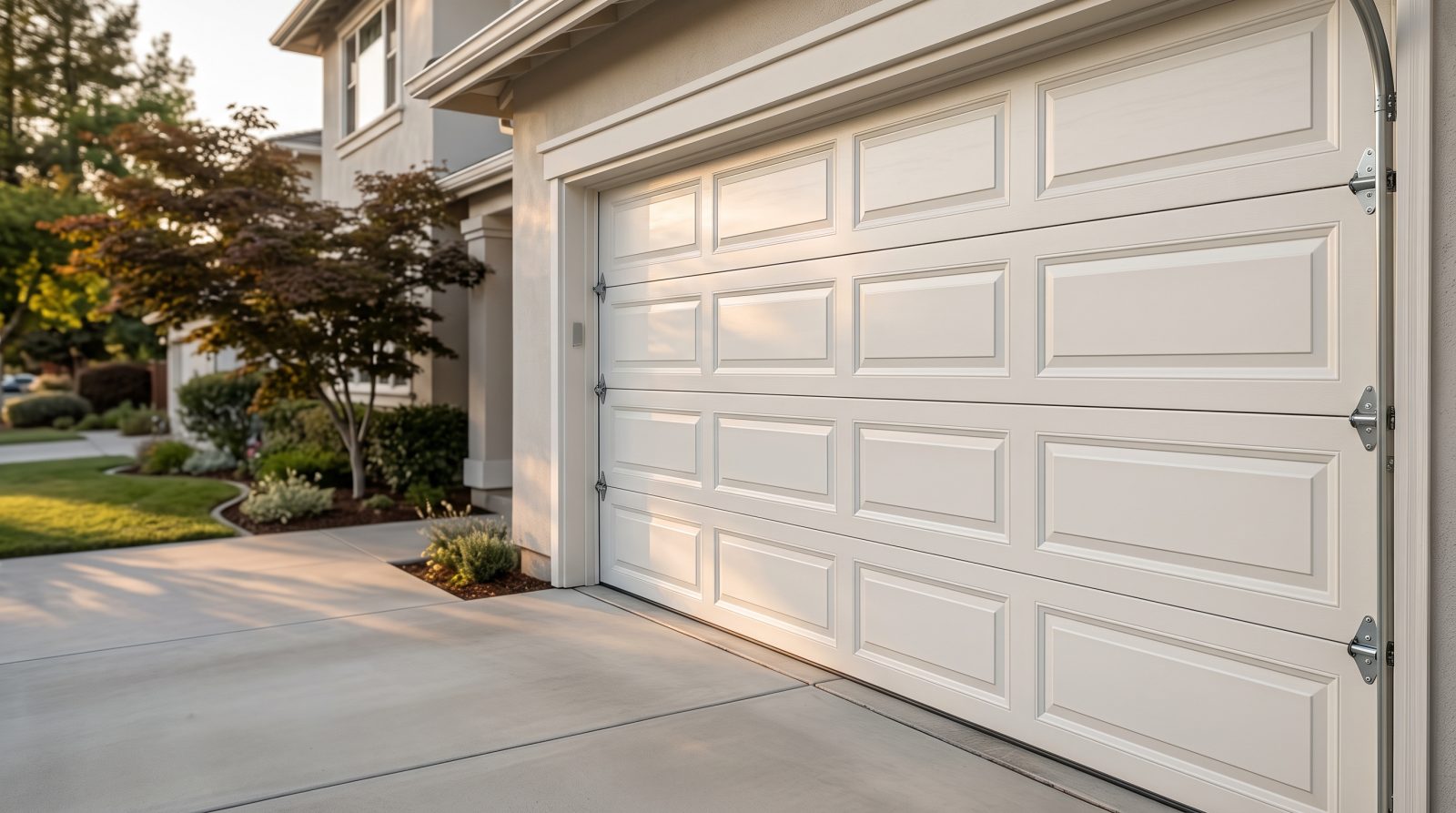
What Is a Sectional Garage Door (and Why San Diego Homes Use It)
A sectional garage door is built from several horizontal sections, or panels, that are connected to each other with hinges. When the door opens, each panel pivots at its hinge and follows a set of tracks that curve from vertical to horizontal, carrying the whole door up and back so it sits parallel to the garage ceiling. When it closes, gravity and the track guide the panels back down into a flat, sealed wall. This panel-and-track design is what separates a sectional door from older one-piece tilt-up doors, which swing out as a single slab and need clearance in front of the garage to operate.
The reason sectional doors dominate San Diego is practical. They open straight up, so they do not need driveway clearance, which matters on the tight lots and short driveways common across neighborhoods like Normal Heights, Clairemont, and the older parts of Pacific Beach. They seal well against the door opening, which keeps out dust, marine-layer moisture, and the fine debris that blows around during Santa Ana conditions. And because the panels are independent, a single damaged section can often be addressed without replacing the entire door, which keeps repair sensible and affordable.
Whether your home is an older tract house in Allied Gardens or a newer build in Carmel Valley, the underlying mechanics are the same. Understanding those mechanics helps you recognize when something is genuinely wrong versus when a door just needs routine attention.
- Multiple hinged panels that bend around a curved track and roll up overhead
- Opens vertically, so no driveway clearance is needed for tight San Diego lots
- Seals tightly against marine-layer moisture, dust, and wind-blown debris
- Individual panels can often be serviced without replacing the whole door
- The standard door type on the vast majority of San Diego homes
How the Parts Work Together: Panels, Rollers, Tracks, Springs and Cables
A sectional door looks simple from the driveway, but it is a balanced system where each component depends on the others. The panels are the visible face of the door, typically steel, aluminum, or composite, and sometimes insulated with a foam core that helps moderate garage temperature, which is a real benefit for garages used as gyms, workshops, or home offices in our warm inland valleys.
Along both sides, small wheels called rollers ride inside the vertical and horizontal tracks, guiding the door up and over. The tracks themselves must stay straight and properly aligned, because even a small bend or a loose mounting bracket will make the door bind, scrape, or jump. The real lifting work, though, is done by the springs. Most sectional doors use a torsion spring mounted on a shaft above the opening, which winds and unwinds to counterbalance the door's weight. Some older or lighter doors use extension springs that run along the horizontal tracks instead. Steel lift cables connect the bottom of the door to the spring system and physically carry the load.
Your garage door opener does far less than people assume. It does not lift the full weight of the door. The springs do that, and the opener simply nudges a properly balanced door the rest of the way. This is why so many opener complaints are actually spring or balance problems in disguise, and why a real diagnosis looks at the whole system rather than just the motor.
- Panels: the steel, aluminum, or composite sections; insulated cores help in warm valleys
- Rollers: side wheels that ride the track and guide the door's travel
- Tracks: must stay straight and aligned or the door binds and scrapes
- Springs: torsion or extension springs do the actual lifting and counterbalancing
- Cables: steel lines that connect the door to the springs and carry the weight
- Opener: only guides a balanced door; it is not the muscle
Common Sectional Door Problems We See Across San Diego
Because sectional doors are everywhere here, we see the same failure patterns again and again, and many of them are shaped by San Diego's specific conditions. Homes within a few miles of the coast, in spots like Ocean Beach, Point Loma, and Encinitas, deal with salt-laden marine air that accelerates corrosion on springs, cables, hinges, and roller bearings. Rust does not just look bad, it weakens steel components and is a frequent reason springs and cables fail earlier than they otherwise would.
Inland and in the canyons, the bigger enemies are heat cycling and grit. Fine dust works its way into rollers and hinges, and dry, unlubricated parts start to grind, squeal, and wear unevenly. A door that has gotten loud or jerky is usually telling you the moving parts are starving for maintenance. Other widespread issues include a door that comes off its tracks after a roller fails or a bracket loosens, a single dented or cracked panel from a backed-into bumper or a stray basketball, and weather seals at the bottom that have dried out and cracked, letting water and pests in.
The most serious category is anything spring-related. A broken torsion spring usually announces itself with a loud bang, after which the door becomes extremely heavy and will not open properly. Springs and cables are under tremendous tension and are genuinely dangerous to handle without the right tools and training. This is exactly the kind of repair to leave to a professional rather than attempt yourself.
- Coastal corrosion on springs, cables, hinges, and rollers near the ocean
- Squealing, grinding, or jerky travel from dry, grit-clogged moving parts
- A door off its tracks after a failed roller or loosened bracket
- Dented or cracked individual panels from impacts
- Worn, cracked bottom weather seals letting in water and pests
- Broken springs or frayed cables, the most dangerous and highest-priority repairs
Repair, Tune-Up, or Replace: How to Decide
One of the advantages of a sectional door is that you usually have options. Because the door is modular, many problems are genuine repairs rather than full replacements. A broken spring, worn rollers, a frayed cable, a loose track, or a tired weather seal are all individual fixes that restore a door without replacing it. If the panels themselves are sound, repairing the hardware is almost always the smarter, more affordable path.
A tune-up is the in-between option that prevents most emergencies in the first place. It typically includes lubricating the rollers, hinges, and springs, checking and tightening hardware, testing the door's balance, inspecting cables for fraying, and confirming the safety reversal features work. In our climate, where salt air and grit are constantly working against your hardware, periodic maintenance genuinely extends the life of the whole system and is far cheaper than reacting to a failure.
Replacement makes sense when the panels are extensively rusted, multiple sections are dented or cracked, the door is so old that parts are hard to source, or you simply want a better-insulated, quieter, more secure door. A modern insulated sectional door can also cut down on heat and noise, which homeowners notice most in garages that double as living or working space. As a rough guide, parts-level repairs sit at the lower end of the cost spectrum, full spring or hardware overhauls in the middle, and complete door-and-hardware replacement at the top. These are general industry ranges, and the only way to know your number is an on-site look, which is exactly what our free quote is for.
- Repair: best when panels are sound and only hardware has failed
- Tune-up: lubrication, hardware tightening, balance and safety checks to prevent failures
- Replace: when panels are rusted or damaged, parts are obsolete, or you want better insulation
- Cost climbs from single-part repairs, to full hardware overhauls, to complete replacement
- On-site assessment is the only accurate way to price your specific door
Mobile, Same-Day Sectional Door Service Across San Diego
We come to you. Every sectional door repair, tune-up, and replacement we do happens right in your driveway, because we are a fully mobile garage door company serving the San Diego area. There is no shop to drive to and no door to drag anywhere. We bring the tools, the common replacement parts, and the experience to your home, diagnose the door in front of you, and explain plainly what is happening before any work begins.
Being mobile is the right fit for how San Diego is laid out. The region sprawls from the coast to the inland valleys to the South Bay, and a door that will not open is not a problem you want to schedule around a long shop trip. We serve homeowners throughout the area, including communities like La Jolla, Pacific Beach, Clairemont, Carmel Valley, El Cajon, La Mesa, Chula Vista, and the neighborhoods in between. We offer same-day service where availability allows, which matters a great deal when your car is trapped inside or your door will not close and lock for the night.
When you reach out, you get a straightforward, no-pressure assessment and a free quote based on what your door actually needs, not a guess over the phone. If you are hearing new noises, seeing a sagging or crooked door, or staring at a section that will not budge, the safest move is to stop using the door and have it looked at before a small issue becomes a dangerous one.
- Fully mobile: every repair and replacement done at your home, never a shop visit
- Serving homeowners across coastal, inland, and South Bay San Diego
- Same-day service available depending on the day's schedule
- Free, on-site quote with a clear explanation before any work starts
- Call or request a free quote and we will come to your driveway