How Roll-Up and Coiling Doors Actually Work
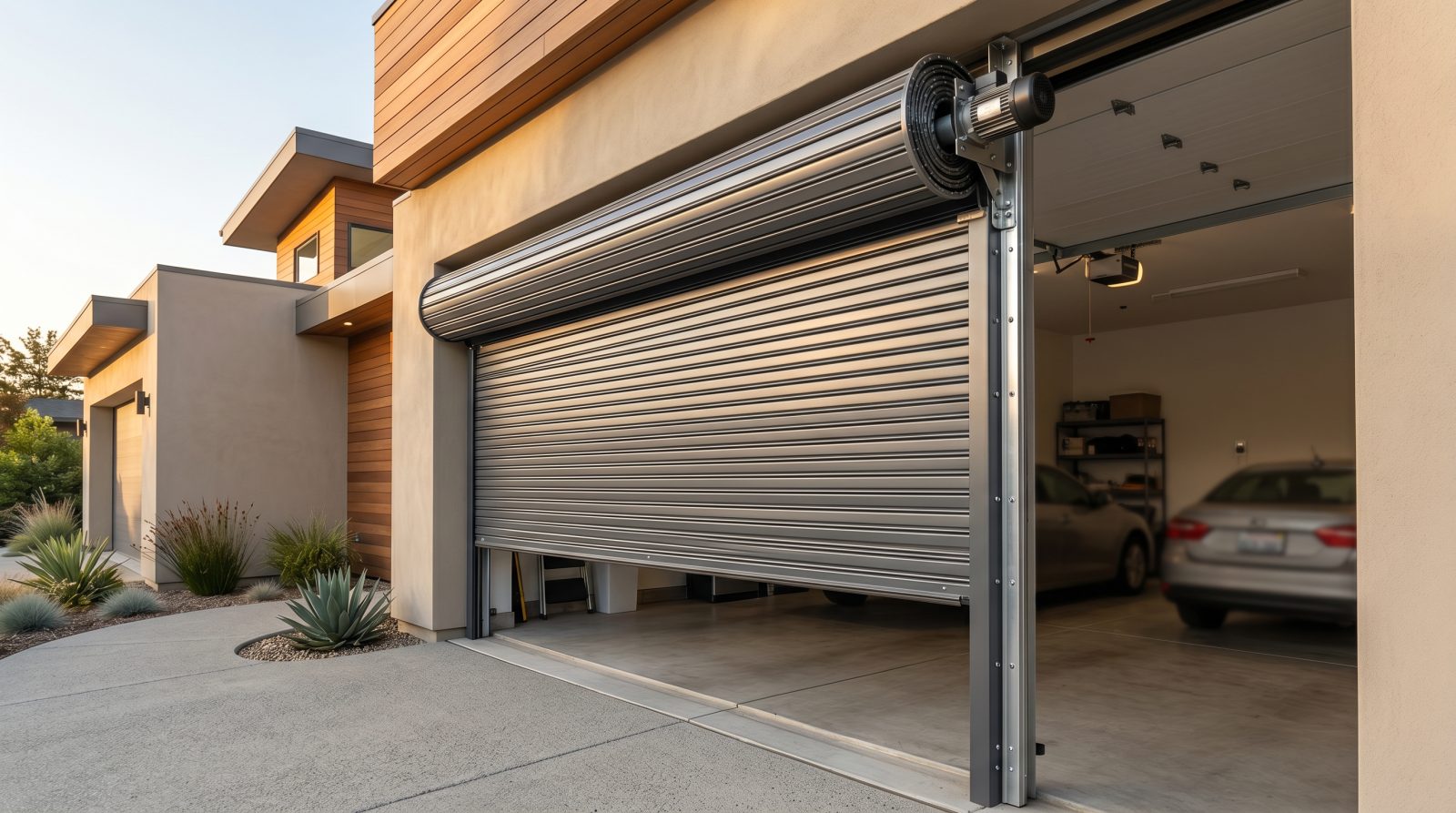
A roll-up door is built from interlocking horizontal slats (the curtain) that wind around a steel barrel mounted above the opening. As the door opens, the curtain coils onto the barrel and disappears into a hood at the top of the wall; as it closes, gravity and a counterbalance spring inside the barrel let the curtain pay out down a pair of vertical guides on either side. Because the curtain rolls up rather than riding back along horizontal ceiling tracks, you keep the headroom and the entire depth of the bay free — which is exactly why so many San Diego shops, garages, and compact homes choose them.
There are two families people lump together. Light-duty roll-up doors (think the slatted steel doors on a residential garage, a self-storage unit, or a small shop) use a thinner curtain and a spring-loaded barrel. Heavier rolling steel and rolling-grille doors — the kind you see on warehouses, parking structures, and security gates downtown — use thicker slats, larger barrels, and sometimes a motor-and-chain hoist instead of a simple spring. Coiling doors and fire-rated rolling doors are close cousins; the fire-rated versions add a release mechanism designed to drop the curtain automatically in an emergency, which is a code-driven repair we treat carefully.
The parts that wear are the same across the family: the counterbalance spring inside the barrel, the bottom bar and its astragal seal, the slats themselves, the side guides, the hood, and on motorized units the operator, chain, and limit switches. When a roll-up door 'won't go up,' the problem is almost always in one of those components — and because they live inside or above the opening, this is not a job to muscle by hand.
- Curtain: interlocking slats that coil onto the barrel — the visible 'door'
- Barrel and counterbalance spring: the hidden tube and spring that carry the curtain's weight
- Side guides: the vertical channels that keep the curtain tracking straight
- Bottom bar and astragal: the reinforced base slat plus the weather seal that meets the floor
- Hood: the cover at the top that hides the coiled curtain and keeps debris out
- Operator (on motorized units): the motor, chain or direct drive, and limit switches that set open/close stops
Where Roll-Up Doors Make Sense in San Diego
Commercially, roll-up and coiling doors are everywhere across the county for a reason. In the industrial pockets of Kearny Mesa, Miramar, and Otay Mesa, warehouses and distribution bays need wide, durable openings that take daily abuse and don't steal ceiling space from racking or lifts. In Barrio Logan, Logan Heights, and the Morena/Bay Park flex spaces, you'll find rolling steel doors on auto shops, fabricators, breweries, and maker studios where security after hours matters as much as daytime access. Downtown and in Little Italy, rolling grilles secure parking structures and retail frontages while still letting air and sightlines through.
On the residential side, roll-up doors quietly solve San Diego's space problem. Older neighborhoods like North Park, Golden Hill, University Heights, and parts of La Mesa have compact detached garages and alley-access structures where a traditional sectional door's horizontal tracks would swallow the limited ceiling. A roll-up curtain that coils into a tidy hood is often the only door that fits — and it turns a cramped garage back into usable storage, a workshop, or a parking spot you can actually walk around. The same logic applies to live-work units, ADUs, and converted carriage structures throughout the central neighborhoods.
Coastal placement matters too. Properties near the water — Point Loma, Ocean Beach, Pacific Beach, Imperial Beach, and Coronado — sit in San Diego's salt-air marine layer, and that environment is hard on bare steel. Where roll-up doors face that exposure, material choice (galvanized and properly finished steel, or aluminum for grilles) and routine maintenance make the difference between a door that lasts and one that streaks with rust and binds in its guides within a couple of seasons.
- Warehouses and distribution bays: Kearny Mesa, Miramar, Otay Mesa, Sorrento Valley
- Flex and industrial-arts spaces: Barrio Logan, Logan Heights, Morena, Bay Park
- Retail frontages and parking structures: Downtown, Little Italy, Gaslamp
- Compact and alley-access home garages: North Park, Golden Hill, University Heights, La Mesa
- ADUs, live-work units, and converted carriage garages across the central neighborhoods
- Coastal exposures where salt air drives material and maintenance decisions: Point Loma, OB, PB, Coronado
Common Roll-Up Door Problems We Fix On Site
The single most common failure is the counterbalance spring inside the barrel losing tension or breaking. When that happens, the curtain feels brutally heavy, won't stay up, or won't open at all on a manual door — and on a motorized unit the operator strains, slips, or trips its overload. Re-tensioning or replacing a barrel spring is precise, high-tension work; it is the part of a roll-up door most likely to injure someone who tries it without the right tools, so it's the most important reason to have a mobile tech handle it rather than improvising.
Right behind spring problems are curtain and guide issues. Slats get bent or 'jumped' out of the side guides after a forklift bump, a delivery-truck mirror, or a backed-into bottom bar — extremely common on busy commercial bays. The door then binds, scrapes, or jams partway. We can often straighten or re-seat a curtain, replace a run of damaged slats, and clean and realign the guides on the spot. We also see worn or torn astragal seals at the bottom bar, which let water, dust, and pests under the door — a real issue during San Diego's winter rains and in dusty inland and industrial zones.
Coastal corrosion deserves its own mention. Salt air rusts barrels, guides, and slat hems near the beach, which makes a once-smooth door grind, squeal, and eventually seize. We address the cause, not just the symptom: cleaning and lubricating the guides and barrel, replacing badly pitted hardware, and advising on finishes or materials that hold up better in the marine layer. On motorized commercial doors, we also troubleshoot operators, chains, limit switches, photo-eye safety sensors, and the wiring and controls that fail with age and weather.
- Broken or weak barrel counterbalance spring — door heavy, won't stay up, operator straining
- Curtain jumped out of the guides or bent slats after an impact — door binds or jams partway
- Worn astragal/bottom seal letting in water, dust, and pests
- Salt-air corrosion on barrels, guides, and slats causing grinding and seizing
- Failed operator, chain, limit switches, or photo-eye sensors on motorized commercial doors
- Damaged or rusted side guides knocking the curtain off-track
Repair, Replace, or Install: How We Help You Decide
Not every tired roll-up door needs to be replaced, and we don't push that. When the curtain is sound and the structure is straight, a targeted repair — a new spring, a few replacement slats, fresh guides, a new bottom seal, or an operator service — usually gets the door running smoothly again for far less than a full replacement. We'll show you what's worn, what's still good, and the honest trade-off so you can decide with real information rather than pressure.
Replacement starts to make sense when the curtain is corroded through, repeatedly off-track from accumulated impact damage, undersized or underbuilt for how the opening is actually used, or so old that parts are hard to source. For commercial clients, the size and cycle rating of the door matter: a bay that opens and closes dozens of times a day needs a heavier, higher-cycle door and operator than a unit that opens twice. For homeowners, the decision usually balances appearance, security, weather sealing, and quiet operation.
When you need a brand-new opening fitted — a new ADU garage, a converted bay, a security upgrade on a storefront — we install roll-up and coiling doors sized to the opening and the duty. Because every San Diego property is a little different, especially the older central-neighborhood garages and the mixed-use industrial buildings, we measure on site and recommend the right curtain, barrel, and operator rather than forcing a stock unit. As a fully mobile operation, we come to you for the assessment, the work, and the follow-up — there's no shop to drive to and no door to haul off site yourself.
On pricing: roll-up and coiling door work spans a wide range because a residential light-duty spring replacement and a high-cycle commercial rolling-steel door are not remotely the same job. Light repairs land at the low end of the industry range; full commercial replacement with a new motorized operator sits much higher. We quote your specific door and opening before any work begins, so you know the number first — any cost ranges you see here are general industry figures, not a quote for your door.
- Repair makes sense when: curtain and structure are sound, wear is isolated (spring, slats, guides, seal, operator)
- Replace makes sense when: corrosion-through, chronic off-track damage, under-built for the duty cycle, or parts obsolete
- Commercial sizing centers on duty cycle — heavier door and higher-cycle operator for high-traffic bays
- New installs are measured on site and sized to the opening, not forced from stock
- Fully mobile: assessment, repair, and install happen at your location
- Quote provided before work begins; cost spans a broad industry range from light residential repair to commercial motorized replacement
Why San Diego Businesses and Homeowners Choose a Mobile Crew
A roll-up door down means a bay you can't load, a storefront you can't secure, or a garage you can't get into — and across a county as spread out as San Diego, hauling a door or waiting for a stationary shop to fit you in is the last thing you need. Because we're fully mobile, we bring the diagnosis and the fix to you, whether that's a warehouse in Otay Mesa at the start of a shift, a brewery roll-up in Barrio Logan, or a compact garage in North Park. You don't transport anything and you're not tied to shop hours.
Same-day service is the difference-maker for commercial clients especially. A jammed loading-bay door or a security grille stuck half-open is an operational and safety problem, not a someday repair. We prioritize getting doors safely functional fast — secure the opening, restore operation, and, where a part has to be ordered, make the door safe in the meantime so you're not left exposed overnight.
We also work the way San Diego's mix of buildings demands: we're comfortable on both sides of the line, from a homeowner's single light-duty roll-up to a property manager's bank of commercial coiling doors and fire-rated rolling shutters. We'll tell you straight when a door is a quick fix and when it's reached the end of its life, and we'll always quote before we work. That honest, mobile approach is how we aim to earn the next call in a market built on neighborhood word of mouth.
- We come to you anywhere across the county — no door to haul, no shop hours to work around
- Same-day, safety-first response for jammed bays and stuck security grilles
- Comfortable across the spectrum: residential roll-ups to commercial coiling and rolling-steel doors
- Honest repair-vs-replace guidance and a quote before any work
- Local crew that understands San Diego's coastal salt air and older-garage realities