What a Smart Garage Door Opener Actually Is
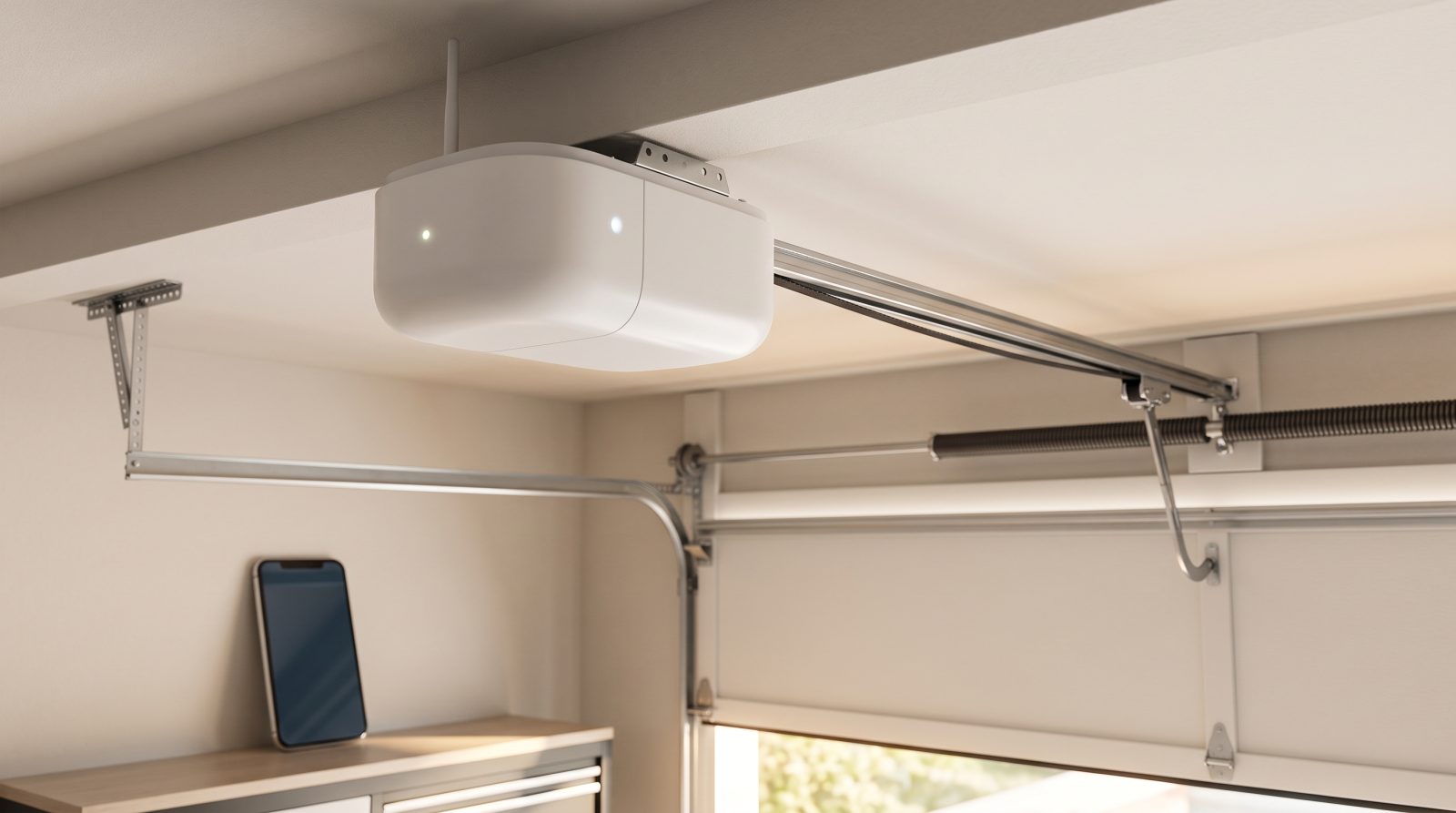
At its core, a garage door opener is a motor that pulls the door up and lets it down along a track. What makes an opener "smart" is connectivity: a WiFi radio (and sometimes Bluetooth) that links the motor to your home network and, through that, to an app on your phone. Once connected, the opener can report its status, accept open and close commands from anywhere with an internet connection, send alerts, and integrate with other smart-home systems. The mechanical job is identical to a basic opener; the difference is the brain and the antenna bolted to it.
There are two broad ways to get smart features. The first is a fully integrated smart opener, where the WiFi, app control, and often a camera or battery backup are built into the motor unit from the factory. The second is a retrofit controller, a small separate device that wires into the existing opener's terminals and a sensor that detects whether the door is open or closed. Retrofit kits are how an older, otherwise-working opener becomes phone-controllable without replacing the whole unit. Both approaches are legitimate; which one fits depends on the age and condition of what you already have.
It helps to separate three layers when you shop: the motor and drive (the muscle), the connectivity (the WiFi brain), and the accessories (cameras, keypads, battery backup, sensors). A premium motor with weak app software can be frustrating, and a great app bolted onto a worn-out 20-year-old motor only delays the inevitable repair. The best outcome matches a sound, correctly-sized motor to reliable connectivity for your specific door and garage layout.
- Integrated smart opener: WiFi, app, and often camera/battery backup built into the motor from the factory.
- Retrofit smart controller: a small add-on box plus a door-position sensor that makes an existing opener app-controlled.
- Three layers to evaluate separately: the motor/drive, the connectivity, and the accessories.
- "Smart" describes the control and reporting features, not the lifting mechanism, which works the same as a standard opener.
How WiFi and App Control Work, Step by Step
When you tap "open" in the app, the command travels from your phone to the manufacturer's cloud service over the internet, then back down to the opener through your home WiFi, which finally tells the motor to run. That round trip is why a strong, stable WiFi signal reaching the garage matters more than people expect. Garages are often the farthest room from the router, separated by a wall, the kitchen, and sometimes the refrigerator, so a door that connects fine on setup day can drop offline weeks later when the signal is marginal.
Most smart openers use a 2.4 GHz WiFi band rather than the faster 5 GHz band. That is intentional: 2.4 GHz travels farther and penetrates walls better, which suits a device sitting at the edge of the network. If your router combines both bands under one name, the opener usually finds the right one, but homes with separate network names occasionally need the 2.4 GHz network selected during setup. Knowing this ahead of time prevents the most common install-day snag.
Beyond the basic open and close, app control unlocks the features people actually use day to day: real-time status so you can confirm the door is closed, push notifications when it opens or closes, scheduled auto-close after a set number of minutes, and shared access so family members or a house cleaner get their own permission instead of a shared remote. Many systems also tie into voice assistants and broader smart-home platforms, and some require a verification PIN before voice commands will close, or refuse to open by voice at all, as a safety measure.
Reliability comes down to a few unglamorous fundamentals: adequate WiFi signal at the motor, current firmware, and a sensible network setup. We routinely see "the app stopped working" calls that trace back to a router change, a new internet provider, or a weak signal rather than a faulty opener. When we install on-site, we test the actual signal strength at the ceiling where the motor lives, not just somewhere in the garage, because that is where the radio has to perform.
- Tapping the app sends a command to the manufacturer's cloud, then down through your home WiFi to the motor.
- Smart openers typically use the 2.4 GHz band because it reaches farther and through walls better than 5 GHz.
- Core features: live open/closed status, open/close alerts, scheduled auto-close, and individual shared access.
- Most outages we see are network-related (router swap, new ISP, weak signal), not the opener itself.
- Voice control often requires a PIN to close, or blocks voice opening entirely, for safety.
Belt, Chain, Screw, and Jackshaft: Choosing the Right Drive
Smart connectivity is available across every drive type, so the choice of mechanism is really about noise, maintenance, and your garage's physical layout. Belt-drive openers use a reinforced rubber belt and are the quietest option, which is why they are a popular upgrade for homes where a bedroom or living space sits directly above or beside the garage. For many San Diego floor plans, especially two-story homes and condos with a room over the garage, the noise difference between a belt and an old chain is the single most noticeable improvement.
Chain-drive openers use a metal chain and are more affordable and extremely durable, but they are louder and vibrate more. They are a sound choice for a detached garage or a workshop where noise is not a concern. Screw-drive openers use a threaded steel rod; they have fewer moving parts and handle wider, heavier doors well, though they can be more sensitive to temperature swings, which matters less in our mild coastal climate than in regions with hard freezes.
Jackshaft (wall-mount) openers are a different animal worth knowing about. Instead of a motor hanging from the center of the ceiling, the unit mounts on the wall beside the door and turns the torsion bar directly. This frees up overhead space entirely, which is ideal for garages with high or cathedral ceilings, overhead storage racks, a car lift, or low headroom where a standard rail won't fit. Many jackshaft models include smart connectivity and an integrated lock, and they pair naturally with the cleaner look a lot of newer San Diego builds are going for.
The right drive also depends on the door itself. A heavy solid-wood or fully insulated door needs adequate motor power and the correct spring system behind it; the opener does not lift the door alone, the springs carry the weight while the motor guides it. When we evaluate on-site, we look at the door's weight and balance first, because pairing a quiet smart opener with worn-out or mismatched springs just transfers the strain and shortens the new motor's life.
- Belt drive: quietest; best for living space above or next to the garage, and a popular upgrade.
- Chain drive: affordable and durable but loud; fine for detached garages and workshops.
- Screw drive: fewer parts, good for wide/heavy doors; temperature-sensitive (a non-issue in mild coastal weather).
- Jackshaft (wall-mount): frees all overhead space; ideal for high ceilings, storage racks, car lifts, or low headroom.
- Drive type aside, the door's springs must be correctly balanced or any new opener works harder than it should.
What San Diego Homes Should Watch For
Living near the coast changes the calculus on hardware. Salt-laden air in beach-adjacent communities like Ocean Beach, Pacific Beach, La Jolla, Coronado, and Imperial Beach accelerates corrosion on springs, rollers, hinges, and exposed metal. A smart opener does not stop that, but choosing corrosion-resistant components and keeping the moving parts lubricated extends the life of the whole system. If your garage faces the ocean breeze, expect to maintain the door hardware a bit more attentively than someone inland in Santee or Poway would.
Garage layout in San Diego varies enormously, from older detached garages in North Park and Normal Heights to newer attached three-car garages in Carmel Valley, 4S Ranch, and Chula Vista. Detached garages raise two practical questions for smart openers: whether reliable WiFi even reaches the structure, and whether the garage has power and a neutral wiring setup the opener needs. We check both on-site, and where WiFi is weak we can advise on extending coverage so the opener stays connected rather than dropping offline every few days.
Our climate is genuinely kind to garage equipment, with no hard freezes and low humidity inland, so temperature-driven failures are rare here. The bigger enemies are sun exposure on south- and west-facing doors, which degrades weather seals and fades finishes over time, and the simple fact that a garage door in a single-car household may cycle thousands of times a year. High-cycle use is a strong argument for a quiet, well-built belt-drive system with a battery backup.
Battery backup deserves a special mention. California law requires that residential garage door openers sold and installed in the state include a battery backup so the door still operates during a power outage. That is not just a regulatory checkbox; in a region that occasionally sees planned power shutoffs, a backup battery means you are not manually wrestling a heavy door, or worse, stuck unable to get a car out, when the grid is down. When we install, we confirm the backup is present, charged, and functioning.
- Coastal salt air (OB, PB, La Jolla, Coronado, Imperial Beach) corrodes hardware faster, so choose resistant parts and keep them lubricated.
- Detached garages (North Park, Normal Heights) need confirmed WiFi reach and proper power/wiring, both checked on-site.
- Mild climate means few temperature failures; sun exposure and high cycle counts are the real wear drivers.
- California law requires a battery backup on residential openers, valuable during planned power shutoffs.
- We assess door weight, balance, and signal at the motor before recommending a specific system.
Security, Safety, and Privacy of Smart Openers
A connected garage door is a connected entry point to your home, so security is not optional. Modern smart openers and quality remotes use rolling-code technology, which generates a new code every time the door operates so a captured signal can't simply be replayed to open the door later. On the app side, protect the account the same way you would online banking: a strong, unique password and two-factor authentication where the manufacturer offers it. The weakest link is usually a reused password, not the opener itself.
Shared access is one of the genuinely useful safety features. Instead of handing out physical remotes or a universal code, you grant individual app access to family members, roommates, or service people, and you can revoke any one of them instantly without affecting the others. If a phone is lost or a housekeeper's service ends, you remove that single access rather than reprogramming everything. Pair that with open/close notifications and you have a clear, real-time picture of who is using the door and when.
Physical safety features remain essential and are required on residential systems: photo-eye sensors near the floor that reverse the door if something crosses the beam, and auto-reverse force detection that stops and backs off if the door meets resistance. These protect children, pets, and cars. Smart auto-close features should never override them; a well-designed system will refuse to close, or re-open, if the safety sensors are blocked or misaligned. We test these reversal functions on every visit, because a misaligned photo-eye is one of the most common and most overlooked problems we find.
On privacy, openers that include a built-in camera record video that is typically stored in the manufacturer's cloud, sometimes behind a subscription. That is a reasonable trade for many homeowners, but it is worth knowing where footage lives, who can access it, and whether a monthly fee applies before you rely on it. If a camera matters to you, factor the ongoing service cost into the decision rather than just the hardware price.
- Rolling-code remotes generate a new code each use, defeating simple signal-replay attacks.
- Protect the app account with a strong, unique password and two-factor authentication.
- Grant and revoke individual shared access instead of distributing physical remotes or shared codes.
- Required safety features, photo-eye sensors and auto-reverse, must never be overridden by auto-close; we test them every visit.
- Camera-equipped openers store footage in the cloud, often with a subscription, so confirm where video lives and what it costs.
Upgrade or Retrofit? Costs, Lifespan, and Install
The first decision is whether to retrofit your existing opener or replace it. If your current motor is relatively recent, runs quietly, and the door is well-balanced, a retrofit smart controller is often the most economical path: it adds app control and status alerts without the cost of a new motor. If the opener is old, noisy, lacks the now-required battery backup, or is showing signs of wear like grinding, slipping, or inconsistent travel, replacement with an integrated smart unit usually makes more sense than spending on a unit nearing the end of its life.
On cost, treat any published figures as industry ranges rather than a quote, because the real number depends on the drive type, motor power, accessories, and the condition of your door and springs. As a general guide, basic retrofit smart controllers tend to fall in the lower-cost range, mid-grade integrated belt-drive smart openers occupy the middle, and premium systems with cameras, battery backup, and wall-mount jackshaft designs sit at the higher end. Hardware that needs replacing alongside the opener, such as worn springs, cables, or rollers, affects the total, which is exactly why an on-site look gives an honest figure rather than a guess.
A well-installed opener that is matched to a balanced door and maintained should give many years of reliable service. The fastest way to shorten that lifespan is to install a strong motor on a door whose springs are worn or out of balance, forcing the motor to do work the springs should be carrying. That is why our process starts with the door, not the gadget: we check balance, spring condition, rollers, and the photo-eye alignment, then install and configure the opener and walk you through the app, shared access, and safety tests before we leave.
Because we are a mobile, we-come-to-you company serving the San Diego area, the whole assessment and install happens at your home on your real door and your real WiFi, which is where these systems either work well or quietly fail. If you are weighing a retrofit against a full upgrade, the practical next step is a same-day on-site evaluation so the recommendation fits your specific garage. You can call or request a free quote and we will come take a look.
- Retrofit if your motor is recent, quiet, and the door is balanced; replace if it's old, noisy, worn, or lacks battery backup.
- Costs are industry ranges, not quotes: retrofit kits lower, integrated belt drives mid, camera/jackshaft systems higher.
- Worn springs, cables, or rollers add to the total and are the top hidden cause of premature opener failure.
- We start with door balance and safety, then install, configure the app, and test reversal before leaving.
- Mobile service means the install happens on your actual door and WiFi; request a free quote for a same-day on-site look.