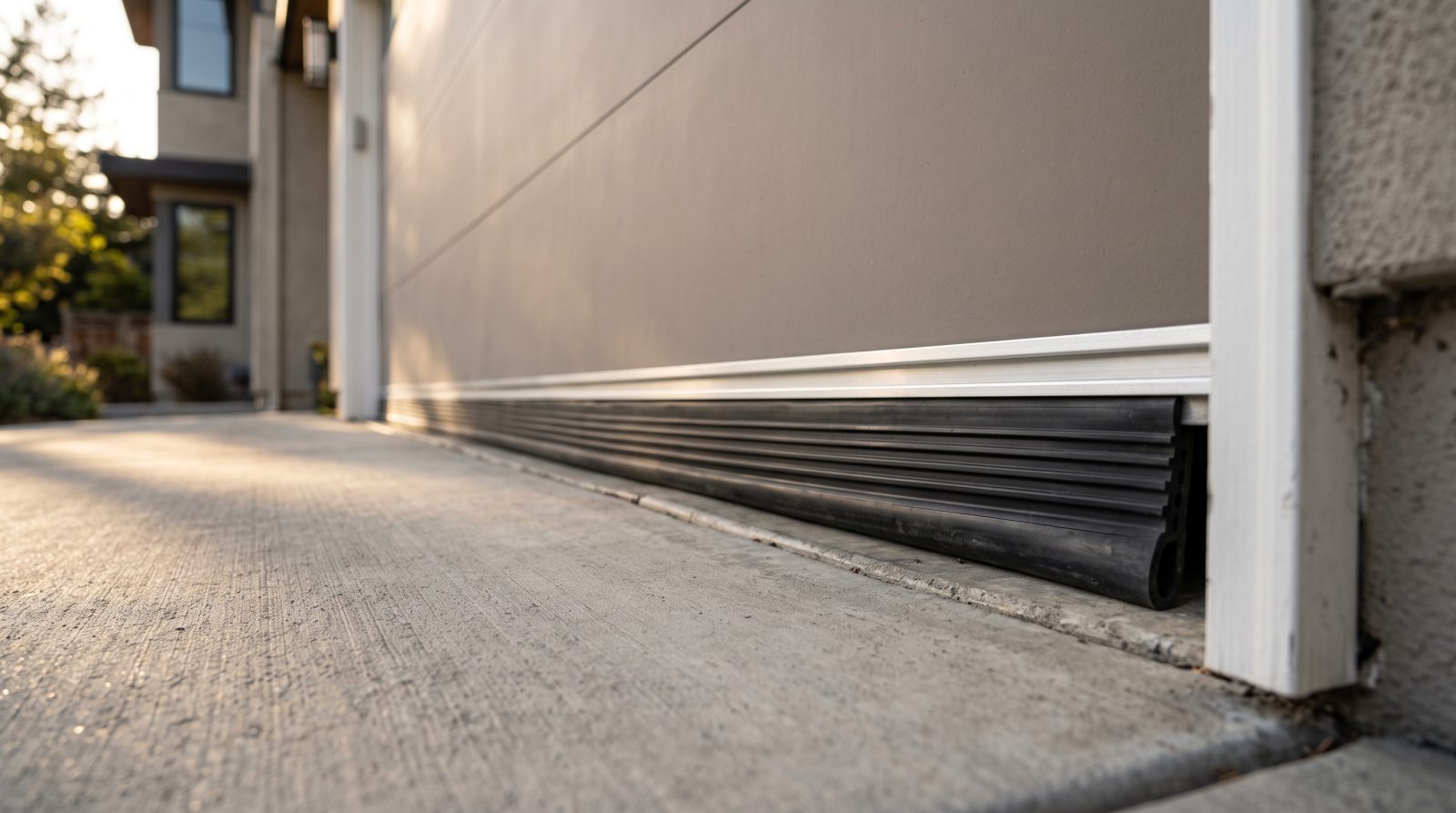
The Four Seals on Your Garage Door (and What Each One Does)
Weatherproofing a garage door is not a single part; it is a system of four distinct seals working together around the opening. When people say their garage 'leaks,' they usually mean one of these has failed, and knowing which one saves time and money. The bottom seal does the heavy lifting against water and pests, but the perimeter and panel seals matter just as much for keeping out wind-driven dust and stabilizing temperature.
The bottom seal (also called the door sweep or astragal) is the long rubber or vinyl gasket that runs along the bottom edge of the door and presses against the concrete when closed. Most modern aluminum doors use a U-shaped or T-shaped retainer track, while older wood doors often have a seal nailed or screwed directly to the bottom rail. This is the part that wears fastest because it is compressed against the slab thousands of times a year.
The perimeter weatherstripping is the flexible strip mounted on the door stop molding around the two sides and the top of the opening, sealing the small gap between the door and the frame. The inter-panel seals (the flexible joints between each horizontal section) help block light and air on sectional doors. Finally, the threshold seal is a separate rubber strip bonded to the floor itself, used when the slab is uneven or you want extra protection against water and rodents.
- Bottom seal / astragal: the main barrier against water, leaves, dust, and pests at floor level
- Perimeter weatherstripping: seals the sides and top against wind-driven rain and drafts
- Inter-panel seals: block light and air at the joints between sections on a sectional door
- Threshold seal: floor-mounted strip used for uneven slabs or extra flood and rodent protection
Why San Diego Weather Wears Seals Out Faster Than You'd Think
It is easy to assume our mild climate is gentle on rubber, but San Diego's specific conditions are surprisingly hard on garage door seals. The single biggest factor is sun. A south- or west-facing garage door takes direct UV for hours a day, year-round, and UV is what breaks down the plasticizers that keep vinyl and rubber flexible. Over a few years that once-pliable bottom seal turns stiff, chalky, and brittle, then cracks the first time it is asked to flex over an uneven spot in the slab.
For homes in coastal communities like La Jolla, Pacific Beach, Ocean Beach, Point Loma, Coronado, Encinitas, and Carlsbad, salt air adds a second problem. Salt does not attack the rubber directly, but it corrodes the staples, screws, and aluminum retainer track that hold the seal in place. We routinely find bottom seals that are still intact but flapping loose because the fasteners rusted through. Inland areas like El Cajon, Santee, Poway, and Escondido trade salt for heat, where higher summer temperatures accelerate the same UV breakdown.
Then there is water. San Diego's rainfall is concentrated into a handful of intense winter storms and the occasional atmospheric river. A seal that looked fine all summer suddenly cannot hold back a sheet of water sweeping down a sloped driveway. Because so many local garages sit at or near grade with the driveway pitching toward the door, a worn bottom seal or a low spot in the slab is the difference between a dry garage and an inch of water around your stored boxes and tools.
- Year-round UV is the top cause of seal failure here, especially on sun-facing doors
- Coastal salt air corrodes the fasteners and aluminum track that hold seals in place
- Inland heat in areas like Poway and El Cajon speeds up the same rubber breakdown
- Concentrated winter storms expose worn seals fast, particularly on driveways that slope toward the door
How to Tell Which Seal Has Failed (A Simple Inspection)
You can diagnose most seal problems in a few minutes with the door closed and a flashlight. Stand inside the garage in daytime with the lights off and look around the entire perimeter of the door. Any daylight you can see is an unsealed gap, and the location of that light tells you exactly which seal to address. A line of light along the bottom points to a flattened or torn astragal; light up the sides or across the top points to shrunken or missing perimeter weatherstripping; pinpoints of light between sections mean the inter-panel seals are gone.
Next, inspect the bottom seal physically. A healthy seal is soft and springs back when you press it; a failed one feels hard, looks cracked or chalky, may be torn at the corners, or has folded under and stopped making contact. Check whether it sits flat against the floor along the whole width. On many doors the slab is slightly uneven, so a single straight seal cannot conform to a dip, and that low spot becomes the entry point for water and bugs. If the seal is fine but loose, look for rusted or pulled fasteners and a corroded retainer track.
Finally, pay attention to symptoms inside the garage. Drifts of leaves or fine dust near a particular corner, water stains that always start in the same place, daylight gaps, drafts you can feel with your hand, or evidence of insects and rodents all map back to a specific failed seal. Take a quick photo of any gaps you find; if you request a quote, sharing those photos helps us bring the right seal type and retainer on the first visit.
- Lights-off daylight test: any light around the perimeter marks an unsealed gap
- Press the bottom seal: soft and springy is good, hard or cracked means replace it
- Watch for repeating water stains, leaf or dust drifts, drafts, and pest activity in the same spot
- Loose-but-intact seal usually means corroded fasteners or a damaged retainer track, not the rubber itself
Bottom Seal & Weatherstripping Replacement: What's Involved
Replacing a bottom seal depends entirely on how it is attached. On a typical modern aluminum sectional door, the seal is a flexible insert that slides into a U- or T-shaped aluminum retainer track on the bottom rail. The job is to open the door partway, pull the old worn insert out of the track ends, clean the track of corrosion and debris, lubricate it lightly, and feed the new seal through. The tricky part is matching the seal profile and the track width exactly, because a too-narrow seal slips out and a too-wide one will not feed. On older wood doors, the seal is fastened directly to the bottom rail and replacement means removing rusted nails or screws and re-fastening a new strip cleanly.
Perimeter weatherstripping is more straightforward conceptually: the old strip is removed from the stop molding and a fresh strip is nailed or screwed on so its flexible lip just kisses the closed door, sealing the gap without binding the door as it operates. The skill is in the adjustment, since too much pressure makes the door hard to close or strains the opener, and too little leaves a gap. When the underlying problem is an uneven slab rather than a worn seal, the right fix is often a threshold seal bonded to the floor, which raises the contact line to meet the door evenly across its width.
Because we operate as a mobile service across San Diego County, this is the kind of visit we complete at your home in one trip when the door is straightforward. We assess all four seals while we are there, because it is common to replace a bottom seal and discover the perimeter strip is equally sun-baked. Addressing them together avoids a second trip and a second leak the following month.
- Aluminum doors: slide a new insert into the existing retainer track after cleaning out corrosion
- Wood doors: remove rusted fasteners and re-fasten a new strip to the bottom rail
- Perimeter strips must be adjusted to seal without binding the door or straining the opener
- Uneven slab: a floor-bonded threshold seal often works better than a thicker bottom seal
- A mobile visit lets us check and address all four seals in one stop to prevent repeat leaks
DIY vs. Calling a Pro: Honest Guidance
A simple insert-style bottom seal swap on a modern aluminum door is genuinely within reach for a handy homeowner, and there is no shame in trying it. If your retainer track is in good shape, the seal profile is easy to identify, and the slab is reasonably level, you can buy the matching seal and feed it through. The most common DIY frustrations are buying the wrong profile or track width, struggling to thread a stiff seal (a little soapy water helps), and not realizing the track itself is corroded and needs cleaning or replacement first.
There are clear cases where calling a pro saves money and frustration. If the retainer track is corroded or bent, if your door is a heavier wood or custom door, if the slab is uneven enough that a standard seal will not conform, or if you are also seeing perimeter and inter-panel gaps, a coordinated fix beats piecemeal patching. It is also worth noting that the bottom seal is positioned right next to the lift cables and the bottom brackets, which are under spring tension; you should never loosen a bottom bracket as part of a seal job, and if anything in that area looks worn, it is a safety reason to bring in someone who works on these doors daily.
Costs for seal work are modest compared to most garage door repairs, but they are job-specific, so any figures you see online are industry ranges rather than a quote for your door. The variables that move the price are the seal type and length, whether the retainer track or fasteners also need replacing, the number of seals being addressed, and door size. Rather than guess, the honest answer is that a quick look at your door, even from a few photos, lets us give you a real number. If you would like that, you can request a free quote and we will come to you anywhere in our San Diego service area.
- Good DIY candidate: modern aluminum door, healthy track, level slab, easily matched seal profile
- Call a pro: corroded or bent track, wood/custom door, uneven slab, or multiple failed seals
- Safety note: never loosen the bottom brackets near the lift cables, which are under spring tension
- Pricing varies by seal type, length, track condition, and door size, so any online figure is a range, not a quote
- For an accurate number, request a free quote and we come to you across the county