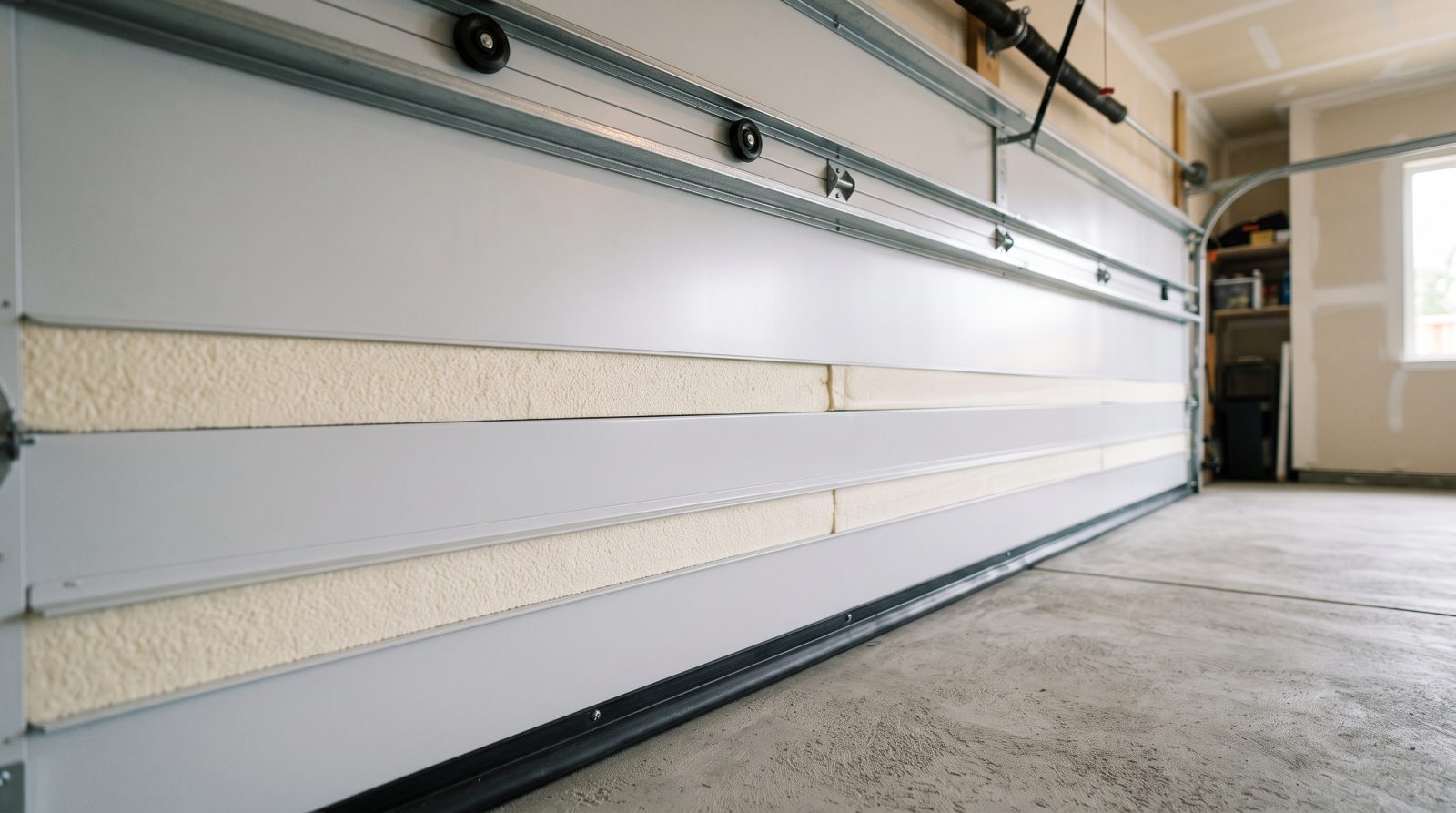
What Garage Door Insulation Actually Does (and Why It Matters Here)
Insulation slows the movement of heat. In San Diego the direction that matters most is heat trying to get in, not out. A bare single-layer steel door sitting in direct afternoon sun can reach surface temperatures well over 130°F, and that heat radiates straight into the garage and then into any room sharing a wall or ceiling with it. Insulation puts a thermal barrier between that hot panel and the air inside, so the garage stays cooler and the heat load on adjacent living space drops.
There's a second job most homeowners overlook: stopping the swing. An uninsulated garage tracks the outside temperature almost exactly, baking in the afternoon and cooling overnight. An insulated garage holds a much steadier, more moderate temperature. That stability is what makes a converted garage gym, a home office, a workshop, or a laundry room actually usable in July and August instead of something you avoid until sundown.
It's worth being honest about what insulation does not do. A door panel can have a great R-value, but if the perimeter seals are cracked, the bottom weatherstrip is flattened, and there are daylight gaps around the frame, hot air leaks in and the rated number means very little. Real-world performance is the panel plus a tight envelope, which is exactly why we look at the whole door on site rather than quoting from a spec sheet alone.
- Cuts summer heat gain into the garage and into rooms behind it
- Reduces how hard your AC works against an attached, sun-baked garage
- Steadies garage temperature so it's usable as a gym, office, or shop
- Dampens noise and rattle for quieter operation
- Adds rigidity, so doors flex less in Santa Ana wind gusts
Understanding R-Value: How Much Do You Actually Need in San Diego?
R-value measures resistance to heat flow; higher numbers resist more. Garage doors are commonly sold anywhere from around R-6 on the light end to the high teens on premium multi-layer doors. The key thing to understand is that R-value scales with diminishing returns. The jump from no insulation to a mid-range door captures most of the comfort benefit. Climbing from there to the very top of the chart adds cost for a smaller and smaller payoff unless your garage is fully conditioned.
Because our climate is mild, San Diego homeowners rarely need to chase the highest numbers. For most coastal and central homes, a door in roughly the R-6 to R-12 range hits the sweet spot — enough to knock down summer heat gain and steady the space without overpaying. The exception is the inland and high-desert-adjacent edges of the county, where afternoon sun is more punishing and a higher R-value earns its keep.
One more nuance: the way R-value is measured matters. The rating usually reflects the center of the panel, not the whole assembly with its rails, seams, and seals. Two doors with the same headline number can perform differently depending on construction — a polyurethane-injected sandwich door (steel/foam/steel) typically outperforms a polystyrene foam-board door at the same nominal rating because the foam bonds to the steel and there are fewer gaps. Construction quality is part of the equation, not just the sticker number.
- Coastal and central San Diego: R-6 to R-12 covers most homes well
- Inland / East County / hotter exposures: lean toward the higher end
- Detached, rarely-used storage garage: minimal insulation may be fine
- Converted, air-conditioned garage room: justify the top of the range
- Polyurethane sandwich doors generally beat foam-board at the same R-value
Your Options: Add-On Insulation Kits vs. a Factory-Insulated Door
There are two realistic paths. The first is insulating the door you already have. Retrofit kits use rigid foam board or foil-faced batts that fit into each panel of a steel door. This is the budget route and it works reasonably well on a door that's structurally sound. The big caveats are weight and fit: insulation adds mass that can unbalance the door, and a kit that's loosely cut or sagging traps air gaps that hurt performance. Vinyl, glass, or wood-look doors often can't take a standard kit at all.
The second path is replacing the door with a factory-insulated, multi-layer unit. These are built as a bonded sandwich, so the insulation, the seals, and the structure are engineered together. You get the best real-world R-value, the quietest operation, the most wind rigidity, and a clean look without DIY foam showing on the inside. It costs more up front, but on an older, dented, or already-failing door it's usually the better long-term value than putting money into a kit on a door that's near the end of its life.
A specialty note for converted garages: if you've turned the garage into a living space, insulating only the door is half the job. The walls, ceiling, and especially the perimeter air-sealing all contribute, and the door's threshold and side seals become much more important. We can scope what's worth doing versus what's overkill for how you actually use the room.
- Retrofit foam/batt kit: lowest cost, best for sound steel doors; re-balance afterward
- Factory-insulated door: best performance, quietest, most durable, higher up-front cost
- Aging, dented, or failing door: a new insulated door usually beats a kit
- Non-steel doors (vinyl/glass/wood): kits often don't apply — ask before buying one
- Costs vary widely by door size, material, and access — ask for a free quote on yours
The Weight Trap: Why Insulation Can Break Your Spring Balance
This is the part DIY guides skip and the part that brings us out on service calls. Your garage door is counterbalanced by springs sized for the door's original weight. Add insulation — whether a retrofit kit or a heavier new door — and you change that weight. If the springs aren't adjusted to match, the door becomes hard to lift by hand, the opener strains and wears out early, and the door can drift or slam because it's no longer balanced.
A correctly balanced door should hold its position when stopped halfway and feel nearly weightless to lift manually with the opener disengaged. After any insulation work, that balance needs to be re-checked and the spring tension corrected if needed. Spring work is also the most dangerous part of a garage door — torsion springs store a lot of energy and should be handled by someone equipped for it, not adjusted with the wrong tools.
When we add insulation or install an insulated door, balancing is part of the job, not an afterthought. We confirm the door lifts smoothly, the opener isn't overworking, the safety reverse still functions, and the seals close tight all the way around. That's the difference between insulation that quietly improves your home and insulation that quietly destroys your opener.
- Insulation adds weight your existing springs may not be sized for
- Symptoms of imbalance: hard manual lift, straining opener, door drifts or slams
- A balanced door holds mid-travel and lifts nearly weightless by hand
- Torsion-spring adjustment is high-tension work — not a safe DIY task
- We re-balance and re-check the safety reverse as part of any insulation job
San Diego-Specific Realities: Coast, Inland, and Salt Air
Microclimate drives the right answer. A garage in Pacific Beach, Point Loma, or Coronado lives in marine air — milder temperatures but salt and humidity that corrode hardware, fasteners, and bare steel faster than inland. There, insulation should be fit so it doesn't trap moisture against the door, and the surrounding metal benefits from corrosion-aware materials and seals that keep damp air out. Heat is less of a problem near the water, so the focus shifts toward durability and a tight envelope.
Move inland — El Cajon, Santee, Poway, Escondido, Ramona, and the eastern county — and the priority flips to heat. These areas see the hottest, longest afternoon sun, and a west-facing garage there is a genuine heat source for the whole house. This is where a higher R-value, light-colored door surfaces, and tight bottom and side seals pay off most clearly. The same door spec that's overkill on the coast can be exactly right in the back country.
Door orientation and use matter as much as the zip code. A south- or west-facing door takes the brunt of the sun and benefits more from insulation than a shaded north-facing one. Older neighborhoods with garages set close to the street — North Park, Hillcrest, the beach communities — also tend to value the noise reduction an insulated door brings. Because all of this is so site-specific, the honest move is to look at your actual door, exposure, and how you use the space, which is exactly what we do when we come out.
- Coastal (PB, Point Loma, Coronado, IB): prioritize corrosion resistance and tight seals over high R-value
- Inland (El Cajon, Santee, Poway, Escondido, Ramona): prioritize heat control and a higher R-value
- West- and south-facing doors gain the most from insulation
- Close-set street-facing garages benefit from the noise reduction
- Mobile service: we assess your exact door and microclimate on site