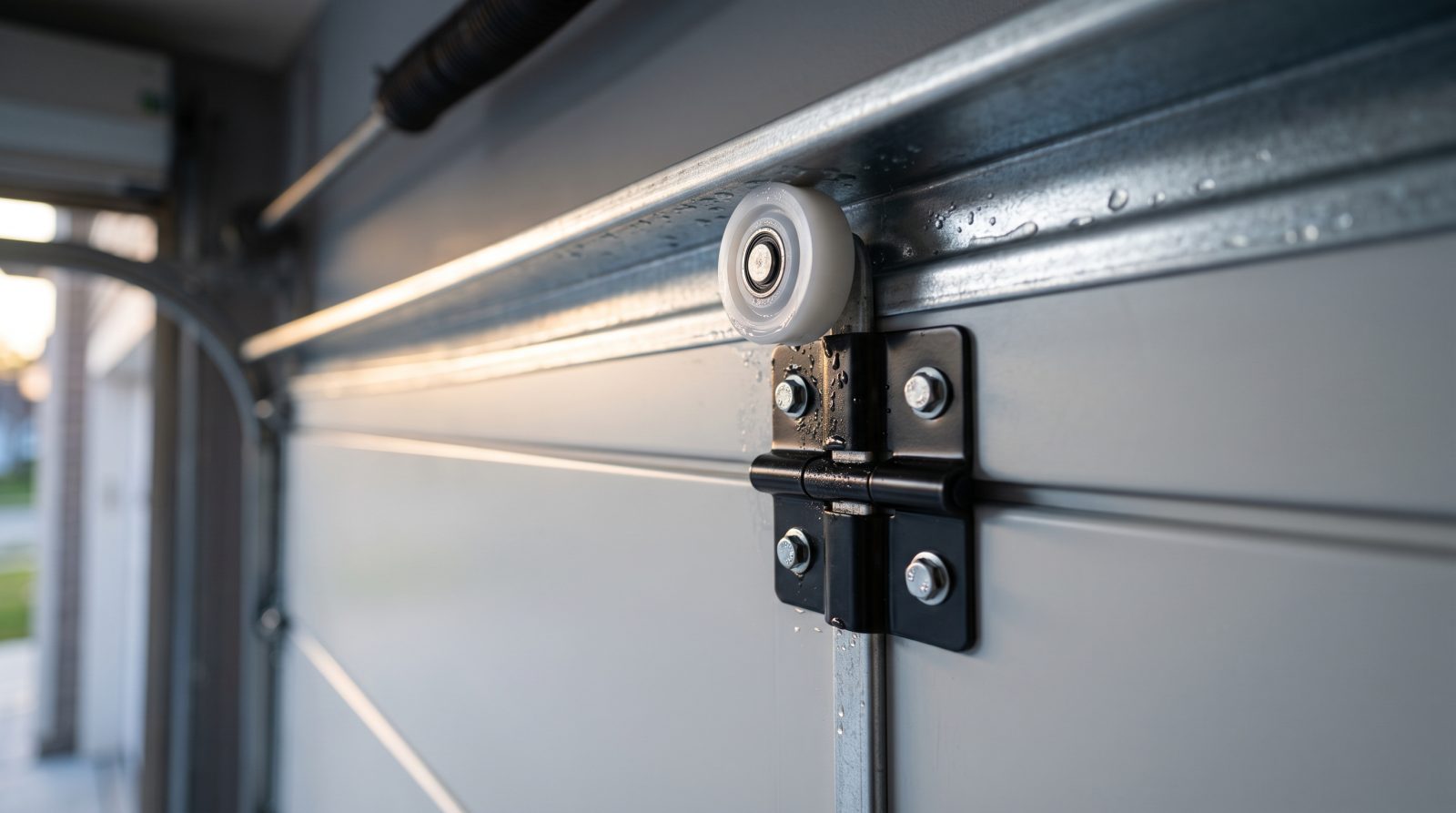
What the Noise Is Actually Telling You
Garage doors are mechanical systems with dozens of moving parts, and each kind of sound tends to point to a specific area. Learning to read the noise is the fastest way to know whether you're facing a five-minute fix or a part that needs replacing. Before anything else, listen with the door moving slowly and try to pinpoint where the sound is coming from: the rollers in the tracks, the spring above the door, the opener motor on the ceiling, or the hinges between panels.
A high-pitched squeak or chirp almost always means friction, usually dry rollers, hinges, or bearings that have lost their lubrication. A loud bang or pop, especially first thing in the morning, can signal a torsion spring under stress or a section binding in cold-stiffened tracks. Grinding or scraping points to metal rubbing metal, often a worn roller, a bent track, or debris caught in the path. A rattle or vibration that travels through the wall usually traces back to loose nuts and bolts that years of cycling have worked loose.
One sound deserves immediate attention: a sharp, firecracker-like snap followed by the door suddenly feeling much heavier or refusing to open. That often means a broken torsion or extension spring, which is a safety issue, not a maintenance one. Stop using the door and call a professional.
- Squeak or chirp: friction, dry rollers, hinges, or bearings needing lubrication
- Grinding or scraping: worn rollers, bent track, or debris in the path
- Rattle or buzzing: loose hardware, chain slack, or a vibrating opener
- Bang or pop on opening: binding panels or a stressed/broken spring
- Slamming or jerky travel: worn rollers, balance issues, or opener trouble
The Most Common Causes (and Why San Diego Is Tougher on Doors)
The leading cause of a noisy door is simply a lack of lubrication. The rollers, hinges, springs, and bearing plates all need a thin film of lubricant to glide quietly, and that film dries out over time. Most doors that have never been serviced are running dry, which is why a noisy door is so often a door that just needs attention rather than parts.
Worn rollers are the next big culprit. Builder-grade doors frequently ship with inexpensive steel or plastic rollers that get loud and rough as they age. Loose hardware is right behind them: every open-and-close cycle creates a small vibration, and over hundreds of cycles a year, nuts and lag bolts gradually back themselves out, letting brackets and tracks rattle. Older chain-drive openers add their own clatter, and a chain that has gone slack will slap and bang on every trip.
San Diego adds a real-world wrinkle that inland guides skip. Homes in coastal communities like La Jolla, Point Loma, Ocean Beach, Pacific Beach, and Coronado sit in salt-laden marine air that accelerates rust on springs, hinges, fasteners, and the bearings that rollers spin on. The daily marine layer keeps things damp well into late morning, and surface corrosion turns smooth-rolling parts into squeaky, grinding ones faster than in drier areas like El Cajon or Santee. Even garages a few miles inland feel it, which is why proactive lubrication and corrosion checks matter more here than in a dry climate.
- Dried-out lubricant on rollers, hinges, springs, and bearings (most common)
- Worn or cheap rollers that have gone rough or developed flat spots
- Loose nuts, bolts, and lag screws shaken free over thousands of cycles
- Slack or worn opener chain that slaps and bangs during travel
- Coastal salt air and marine-layer moisture corroding metal parts faster
Safe DIY Fixes You Can Do Today
A large share of noisy doors quiet right down with a careful tune-up that takes well under an hour and needs only basic tools. The single most effective step is proper lubrication. Use a garage-door-specific lubricant, ideally a lithium or silicone-based spray, not WD-40, which is a degreaser and cleaner rather than a lasting lubricant and can attract grime. Apply it to the rollers (the stems and bearings, not the nylon wheel face), the hinges, the springs, and the bearing plates, then run the door a few times to work it in and wipe off the excess.
Next, tighten the hardware. With the door closed, use a socket wrench to snug up the nuts and bolts on the hinges, brackets, and track mounts, plus the lag screws holding the track to the wall. Firm is the goal, not cranked down hard, since overtightening can strip or warp brackets. While you're there, check the track for debris, dirt buildup, hardened old grease, or a small stone caught in the channel, and wipe the tracks clean with a rag. Do not over-apply lubricant inside the track itself; rollers should roll, not slide through grease.
If your opener is a chain drive, a slightly slack chain that bangs around can often be adjusted at the trolley per the opener's manual. And if your rollers are the original noisy plastic type, upgrading to nylon rollers with sealed bearings is one of the biggest quiet-the-door improvements available, though replacing rollers on a door under spring tension is a job better suited to a pro on all but the simplest setups.
- Spray a lithium or silicone garage-door lubricant on rollers, hinges, springs, and bearings
- Avoid WD-40 as a lubricant; it cleans and evaporates rather than lasting
- Tighten hinge, bracket, and track hardware snug, but never overtighten
- Clear and wipe down the tracks; remove debris, dirt, and hardened old grease
- Adjust a slack chain-drive chain per the opener manual to stop slapping
What You Should Never DIY
Some garage door parts store enormous mechanical energy and can cause serious injury if handled without the right training and tools. The most important rule: never attempt to adjust, loosen, or replace the torsion springs (the springs mounted on the bar above the door) or extension springs (alongside the tracks). These are wound under extreme tension to counterbalance a door that can weigh well over a hundred pounds. A spring or winding bar that slips can break bones or worse, which is exactly why spring work is left to trained technicians.
Similarly, leave the bottom roller brackets alone. The bottom brackets are connected to the spring system's cables and are under the same tension, so loosening one can release that force suddenly. If your noise traces back to a spring, a cable, or the bottom bracket, that's your signal to stop and call a professional rather than push on.
It's also worth knowing your limits with the opener's force and travel settings. Misadjusting them can make a door reverse unexpectedly or, worse, fail to reverse when it should, which is a genuine safety concern for kids, pets, and cars. When a tune-up doesn't quiet the door, or you find rust, fraying cable, or a part that looks bent or cracked, that's the point to bring in a pro who can diagnose the whole system safely.
- Never adjust, loosen, or replace torsion or extension springs yourself
- Don't touch the bottom roller brackets; they're under cable tension
- Avoid guessing at opener force and travel settings tied to auto-reverse safety
- Stop immediately if you see a broken spring, frayed cable, or bent track
- Call a pro for any noise that traces back to springs, cables, or balance
How a Mobile San Diego Service Quiets Your Door
Because we're a mobile, we-come-to-you garage door service, there's no shop to drive to and no door to haul anywhere. A technician brings the tools, lubricants, rollers, and common replacement parts directly to your driveway, whether you're in Chula Vista, Carmel Valley, Escondido, North Park, or anywhere across the county, and works on the door right where it hangs. For most noise issues, that means a fix in a single same-day visit.
A proper noisy-door service is more than a quick spray. A good technician runs a full safety and balance check: testing the door's balance by disconnecting the opener and lifting it halfway to see whether it holds, inspecting rollers and hinges for wear, checking springs and cables for corrosion or fraying, confirming the tracks are straight and clean, and verifying the opener's auto-reverse safety features still work. That whole-system look is what separates a door that's quiet for a week from one that's quiet for the long haul.
From there the fix matches the cause: a deep lubrication and hardware tune-up for a friction or rattle problem, a roller upgrade to nylon for a door that's grown rough and loud, opener adjustment for chain noise, or spring and cable work when the noise points to the balance system. As a general guide, a maintenance tune-up sits at the lower end of typical industry price ranges, roller replacement in the mid-range, and spring or opener repairs higher, depending on parts and door size. Any costs here are labeled industry ranges, not a quote; the honest way to know what your door needs is a look in person. If your door has been squeaking, grinding, or banging, call or request a free quote and we'll come to you.
- Mobile service: we bring tools and parts to your driveway, no shop trip
- Same-day visits available across San Diego County neighborhoods
- Full safety and balance check, not just a quick spray of lubricant
- Fix matched to cause: tune-up, roller upgrade, opener or spring work
- Costs are industry ranges; an in-person look gives the honest answer