How Garage Door Springs Actually Work
Your garage door is one of the heaviest moving objects in your home, often weighing between 130 and 350 pounds depending on whether it's a single-layer steel door or an insulated, multi-section model. The garage door opener doesn't actually lift all that weight on its own. The springs do the heavy lifting by counterbalancing the door so the opener (or your arm) only has to manage a few pounds of effort. When a spring breaks, that counterbalance disappears instantly, and the full dead weight of the door is suddenly working against you.
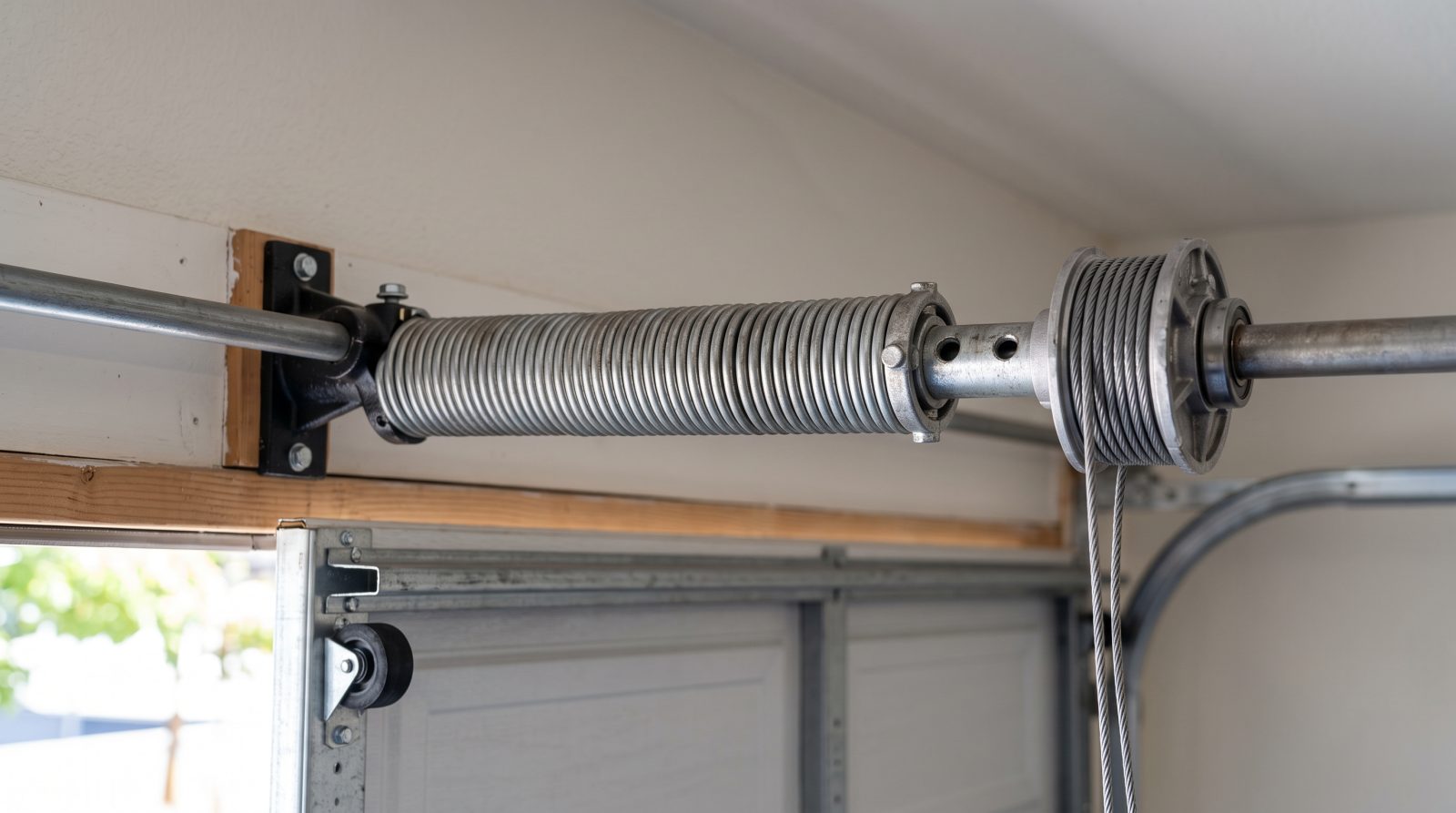
There are two main spring systems, and knowing which one you have helps you understand the repair. Torsion springs mount horizontally on a metal shaft above the door opening and wind up tightly to store energy as the door closes. Extension springs run along the horizontal tracks on either side of the door and stretch out to provide lift. Torsion systems are more common on modern San Diego homes and tend to last longer and operate more smoothly, while extension springs are often found on older doors and lighter single-car setups.
Both systems are precisely calibrated to the exact weight and balance of your specific door. This is why spring replacement is never a one-size-fits-all part swap. The wire size, length, inside diameter, and wind direction all have to match your door, and getting any of those wrong leaves the door either too heavy to lift or so light it flies open. Our mobile techs measure and match springs on site so the balance is correct the first time.
- Torsion springs: mounted on a shaft above the door, smoother and longer-lasting, common on newer San Diego homes
- Extension springs: stretch along the side tracks, often on older or lighter doors
- Springs counterbalance 130-350+ lbs so the opener and your arm barely feel the weight
- Correct spring sizing depends on door weight, height, wire gauge, and wind direction
Why Garage Door Springs Break
The single biggest reason springs break is simply that they wear out. Springs are rated by cycles, where one cycle is the door going up and then back down. A standard spring is often rated for around 10,000 cycles, which sounds like a lot until you realize that a busy family using the garage as their main entrance can easily rack up 1,500 to 2,000 cycles a year. That puts a typical spring on a five-to-seven-year clock, sometimes less. When you hear a loud bang from the garage that sounds almost like a gunshot, that's usually the moment a tensioned spring finally fails.
San Diego's coastal climate adds its own twist. Homes closer to the coast, in areas like Pacific Beach, La Jolla, Point Loma, Ocean Beach, and Coronado, deal with salt-laden marine air that accelerates corrosion on the steel coils. Rust eats into the metal, creates weak points, and shortens spring life noticeably compared to drier inland neighborhoods. We frequently see corrosion-driven spring failures on doors near the water, which is why a rust-resistant or galvanized spring can be a smart upgrade for coastal homeowners.
Other common causes include poor maintenance, where springs are never lubricated and the coils grind against themselves until they fatigue, and improper installation, where a previous repair used the wrong spring size and overstressed the system from day one. Temperature swings between cool coastal mornings and warmer afternoons cause the metal to contract and expand, adding small amounts of stress over time. Finally, builder-grade springs installed when a home was constructed are often the bare minimum and the first thing to go.
- Normal cycle wear: most springs are rated around 10,000 cycles and simply age out in 5-7 years
- Coastal corrosion: salt air near the water in PB, La Jolla, Point Loma, OB, and Coronado rusts coils faster
- Lack of lubrication letting coils grind and fatigue
- Wrong-size springs from a previous DIY or low-quality repair overloading the system
- Builder-grade springs that were the minimum spec when the home was built
Warning Signs You Have a Broken or Failing Spring
A fully snapped spring is obvious, but springs often give warning signs before they completely fail. Catching these early can mean a planned, safer repair instead of a stuck door and an emergency. The most unmistakable sign is a visible gap in a torsion spring, where the coil that used to be a continuous tight wind now has a two-to-three-inch separation. If you can see daylight or a clear break in the spring above your door, do not try to operate the door.
Another telling symptom is a door that suddenly feels extremely heavy or won't open at all with the opener. Many openers will strain, hum, and lift the door only a few inches before stopping, because the safety reverse senses the abnormal weight. Some homeowners try to pull the emergency release and lift the door by hand, only to find it feels like dead lifting a small car, which is exactly what a broken spring leaves you with. You may also notice the door slamming down faster than usual, jerky or crooked movement, or loud bangs and grinding noises during operation.
Importantly, if you suspect a broken spring, stop using the door immediately. Running the opener against a broken spring can burn out the motor, bend the tracks, snap a cable, or send the door crashing down. A quick mobile diagnosis is far cheaper than turning a single broken spring into a full system failure.
- A visible 2-3 inch gap in the torsion spring above the door
- Door won't open, or the opener strains and only lifts it a few inches
- Door feels like dead weight when you try to lift it by hand
- A loud bang from the garage, often mistaken for something falling
- Crooked, jerky movement or the door slamming shut faster than normal
Why Spring Repair Is a Job for the Pros (Safety First)
We're honest with homeowners about this: garage door springs are genuinely dangerous, and spring replacement is the one repair we strongly urge people not to attempt themselves. A torsion spring is wound under several hundred pounds of stored tension. If it slips, releases unexpectedly, or is unwound incorrectly, the winding bars can become projectiles and the spring itself can whip with enough force to break bones, take off fingers, or worse. Emergency rooms see these injuries every year, and they're almost entirely preventable.
Beyond the raw danger, there's the technical side. Replacing a spring correctly requires properly rated winding bars, the exact replacement spring matched to your door's weight and dimensions, and precise winding to the correct number of turns. Too few turns and the door won't open; too many and it becomes dangerously unbalanced. Cheap hardware-store springs and online guesswork are a recipe for a door that's unsafe or fails again within months. There's also the issue of matching parts, because if one spring on a two-spring door has broken, the other is usually close behind, and replacing them as a pair keeps the system balanced.
Our mobile technicians carry a range of professional-grade springs, the correct winding tools, and replacement cables and hardware right in the van. That means we can diagnose, source, and complete most spring repairs in a single visit at your home, without you ever needing to transport heavy parts or visit a storefront. We come to you anywhere in the San Diego area.
- Torsion springs hold hundreds of pounds of tension and can cause severe injury if mishandled
- Correct repair needs rated winding bars, a properly matched spring, and exact winding turns
- We replace springs in matched pairs so the door stays balanced and you avoid a second breakdown
- Fully mobile: our van carries the springs, cables, and tools to finish most jobs in one visit
Our Mobile Spring Repair Process Across San Diego
Because we're a we-come-to-you operation, getting your door fixed is straightforward. When you reach out, we'll ask a few quick questions about your door and symptoms, then schedule a same-day or next-available visit. Our tech arrives at your home, fully equipped, and starts with a safety inspection of the entire system, not just the broken spring. Springs rarely fail in isolation, so we check the cables, rollers, bearings, drums, and tracks to make sure we're not leaving a hidden problem behind.
Once we confirm the right spring specifications for your door, we install professional-grade replacement springs, wind them to the precise correct tension, and rebalance the door so it opens and closes smoothly. We then test the door by hand and with the opener, fine-tune the travel, and lubricate the moving parts so everything runs quietly. Before we leave, we walk you through what we did and how to extend the life of your new springs. We serve homeowners across the county, from coastal neighborhoods like La Jolla, Pacific Beach, and Coronado to inland communities such as El Cajon, Santee, Chula Vista, Escondido, and Poway.
Spring repair pricing varies based on your door type, whether you have a single or dual-spring system, the spring's cycle rating, and any related parts that need attention. As a general industry guide, professional garage door spring replacement commonly falls in a range of roughly $200 to $500, with higher-cycle and dual-spring jobs at the upper end; we'll always confirm the specifics for your door before any work begins so there are no surprises. To get started, call or request a free quote and we'll get a mobile tech headed your way.
- Same-day or next-available mobile scheduling, we come to your driveway
- Full safety inspection of springs, cables, rollers, bearings, drums, and tracks
- Properly matched, professional-grade springs wound to exact tension and rebalanced
- Final hand and opener testing, lubrication, and tips to extend spring life
- Serving coastal and inland San Diego: La Jolla, PB, Coronado, Chula Vista, El Cajon, Escondido, Poway, and more