How Garage Door Lift Cables Work (and Why They Matter)
Most homeowners think the opener does the heavy lifting. It doesn't. The opener only guides the door the last few inches and holds it in position. The real lifting force comes from a counterbalance system: either a torsion spring mounted on a shaft above the opening, or a pair of extension springs running parallel to the horizontal tracks. The lift cables are what physically connect that spring force to the door itself. They run from a fitting at the bottom corner of the door, up the side, and tie into the system at the top.
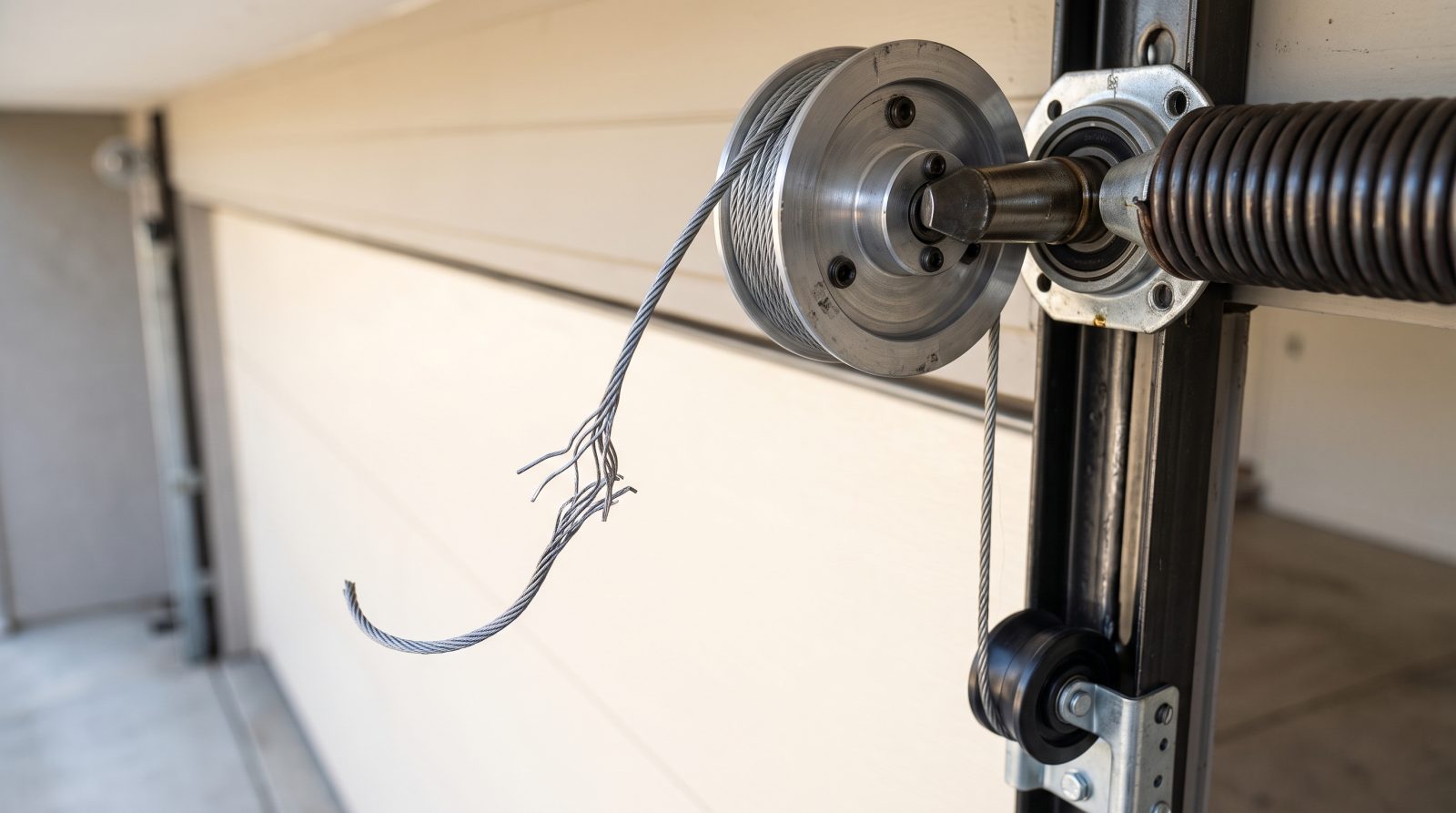
On a torsion setup, the cables wrap around grooved drums on each end of the spring shaft. As the spring unwinds, the drums pay the cable out and the door comes down; as it winds, the drums reel the cable in and lift the door. On an extension-spring door, the cables route through pulleys and let the stretched springs pull the door up. In both designs the cable is the single point that carries the entire balanced weight of the door, often the equivalent of a hundred-plus pounds, on a thin braided steel strand. That is why a small problem with a cable is never a small problem in practice.
Why Cables Fray and Snap in San Diego
Cables don't usually fail overnight. They wear, and there are a handful of causes we run into again and again on San Diego service calls. Understanding the cause matters, because replacing a cable without fixing what wore it out just sets up the next failure.
San Diego's coastal air is a real factor. Homes in Ocean Beach, Point Loma, La Jolla, Pacific Beach, Coronado, and Imperial Beach sit in salt-laden marine air that corrodes steel cable from the outside in. We routinely see rust blooming where the cable seats into the bottom bracket or wraps the drum, even on garages that look clean at a glance. Inland neighborhoods like El Cajon, Santee, and Escondido see less salt but more heat cycling, which is hard on aging extension-spring pulleys.
- Corrosion and rust: marine-layer humidity and salt air weaken the strands over years, especially at the bottom fitting where moisture collects.
- Frayed strands: the braided steel slowly unravels one strand at a time, often after rubbing against a worn drum, a misaligned pulley, or a loose bracket.
- A broken spring: when a torsion or extension spring breaks, the cable suddenly takes a shock load it was never meant to hold alone, and frequently snaps moments later.
- Drum or pulley wear: a grooved, chipped, or seized drum chews the cable; a frozen extension-spring pulley saws into it on every cycle.
- Off-track or jammed doors: if the door binds in the track, the cable can jump the drum, kink, and unwind unevenly.
- Improper past repairs: undersized cable, the wrong drum, or a poorly crimped fitting installed by a previous handyman fails early under load.
The Real Dangers of a Failing Cable
A lift cable is a safety-critical part, not a convenience part. When people try to keep using a door with a frayed or broken cable, the failure modes are genuinely dangerous.
If one of two cables snaps, the door instantly becomes unbalanced. It can drop hard on one side, twist in the tracks, fall off the track entirely, or come crashing down with enough force to damage vehicles, dent panels, and seriously injure a person or pet standing underneath. A door caught mid-travel on a single remaining cable is under uneven, unpredictable tension. We strongly advise against running the opener, parking under the door, or trying to free a stuck door by hand once you suspect a cable problem.
There is also a hidden hazard in the repair itself. The counterbalance springs that the cables tie into store tremendous energy. Trying to swap a cable, especially on a torsion door, without properly winding down and securing the spring is how serious hand and face injuries happen. This is the part of the job that belongs with someone who has the winding bars, the right cable, and the experience to do it safely. Our mobile techs carry that gear in the van.
- Sudden drop: a door on a failed cable can slam shut without warning onto whatever is below.
- Off-track collapse: an unbalanced door can leave the tracks and become a heavy, unstable hazard.
- Property damage: crooked, binding doors crack panels, bend tracks, and strain the opener.
- Injury risk: stored spring energy and a heavy door make DIY cable work genuinely dangerous.
- Cascading wear: ignoring one frayed cable accelerates damage to the opener, rollers, and the second cable.
What Our Mobile Cable Repair Includes
Because we are fully mobile, the technician arrives at your San Diego home or business with cable, drums, fittings, and the safety tools needed to finish the job in one visit. There is no towing a door anywhere and no waiting on parts for a standard residential door.
The visit starts with a full inspection of the counterbalance system, not just the cable that caught your eye. A cable rarely fails in isolation, so we check both cables, the springs, the drums or pulleys, the bottom brackets, and the door's balance. We do this because replacing a snapped cable while ignoring the worn drum that cut it, or the tired spring that shock-loaded it, only buys you a short reprieve.
Once the cause is clear, the tech safely relieves spring tension, removes the damaged cable, and installs correctly sized, properly rated replacement cable matched to your door's weight and drum type. We replace cables in pairs as a rule, because a worn second cable on the opposite side is almost always next in line. Then the door is rebalanced, cycled, and tested so it travels straight, stops where it should, and runs quietly under the opener again.
- Full counterbalance inspection: both cables, springs, drums, pulleys, brackets, and door balance.
- Correct parts: properly rated cable sized to your specific door, not a one-size-fits-all strand.
- Cables replaced in pairs: prevents a fast repeat failure on the matching side.
- Root-cause fix: worn drums, seized pulleys, or failing springs addressed so the new cable lasts.
- Balance and safety test: the door is cycled, leveled, and checked under power before we leave.
- One mobile visit: we come to you anywhere across the San Diego area, same-day where scheduling allows.
Repair Cost: What Drives the Range
Homeowners always want a number, and the honest answer is that cable repair cost depends on what the inspection finds. The following are general industry ranges to help you understand the variables, not a quote for your specific door. A technician confirms pricing on site after seeing the actual condition of the system.
A straightforward cable replacement on a healthy door, where the cable simply wore or rusted out, sits at the lower, more affordable end. The cost climbs when the cable failure is tied to other damage, which is common, because the same event that broke the cable often broke or strained a spring, scored a drum, or knocked the door off track. Door size and weight matter too: a heavy solid-wood or insulated double-car door uses heavier-rated cable and harder-working springs than a light single-car door.
The most useful thing we can tell you is to act early. A frayed cable caught before it snaps is the cheapest version of this repair. The same cable left to break and take a spring or the door's alignment with it becomes a much larger job. Catching the early warning signs is the single best way to keep the cost down.
- Single cable vs. pair: we replace in pairs, but overall scope still affects the total.
- Door size and weight: heavier double doors need heavier-rated cable and stronger counterbalance parts.
- Collateral damage: a broken spring, scored drum, or off-track door raises the scope and cost.
- Cable type and drum match: high-lift or oversized doors require specialized drums and cable.
- Early vs. emergency: a frayed cable caught early is far cheaper than a full failure cleanup.
Warning Signs to Watch For
You usually get a window of warning before a cable fully lets go, if you know what to look and listen for. Catching it in that window turns a potential emergency into a simple, scheduled repair. If you notice any of the signs below on a San Diego door, stop using the door and request a quote rather than forcing it.
Visual checks are easy to do safely from a distance with the door down. Look at the cable running up each side of the door. Healthy cable is smooth and tight; trouble shows up as visible rust, kinks, broken strands sticking out like a wire brush, or a cable that has gone slack and is sagging or coiling at the bottom. A door that suddenly hangs crooked, with one bottom corner higher than the other, is a classic sign a cable has slipped or failed.
- Frayed or broken strands: any wire poking out of the braided cable means it is failing.
- Rust or discoloration: corroded cable, common in coastal San Diego, is weakened cable.
- A slack or sagging cable: a cable that has gone loose has slipped its drum or is on the way out.
- A crooked door: one corner sitting higher than the other points to a cable or spring problem.
- Jerky, uneven, or grinding movement: the door catches, shudders, or makes new noise on travel.
- A loud bang from the garage: often a snapped cable or spring; do not operate the door afterward.