What a Professional Garage Door Tune-Up Actually Includes
A real tune-up is far more than a quick spray of lubricant. It is a systematic inspection and adjustment of every component that affects how your door opens, closes, and keeps your family safe. When we arrive at your home, we work through the full system, from the springs overhead to the contact reverse at the floor, and we adjust as we go rather than just noting problems for later.
The goal is twofold: restore quiet, balanced, effortless operation today, and catch small issues, a fraying cable, a worn roller, a drifting limit setting, before they become an emergency. Most homeowners are surprised how much smoother and quieter the door feels after a single thorough service.
- Spring inspection and tension check on torsion or extension springs, the components doing the heavy lifting
- Cable inspection for fraying, rust, and proper seating on the drums
- Roller and hinge inspection, with lubrication or flagging of worn nylon or steel rollers
- Track alignment check and cleaning, removing debris that causes binding
- Door balance test, disconnecting the opener to confirm the door holds position on its own
- Hardware tightening of brackets, bolts, and lag screws loosened by vibration
- Opener inspection including drive system, force settings, and travel limits
Lubrication Done Right for San Diego's Climate
Lubrication sounds simple, but it is one of the most commonly botched maintenance tasks. Using the wrong product, or the right product in the wrong place, can do more harm than good. Spraying generic oil on the tracks, for example, attracts grit and gums up the rollers, while neglecting the spring coils leads to metal-on-metal grinding and premature failure.
San Diego's environment makes correct lubrication especially important. Homes near the coast, La Jolla, Point Loma, Ocean Beach, Pacific Beach, and the Coronado area, deal with salt-laden marine air that accelerates corrosion on cables, springs, and hardware. Inland communities like El Cajon, Santee, and Poway swing toward dry heat that bakes out lubricant faster than you would expect. A proper tune-up accounts for where you live, using the right products in the right amounts on the components that genuinely need them.
- Spring coils treated with a clinging lubricant to reduce friction and slow corrosion
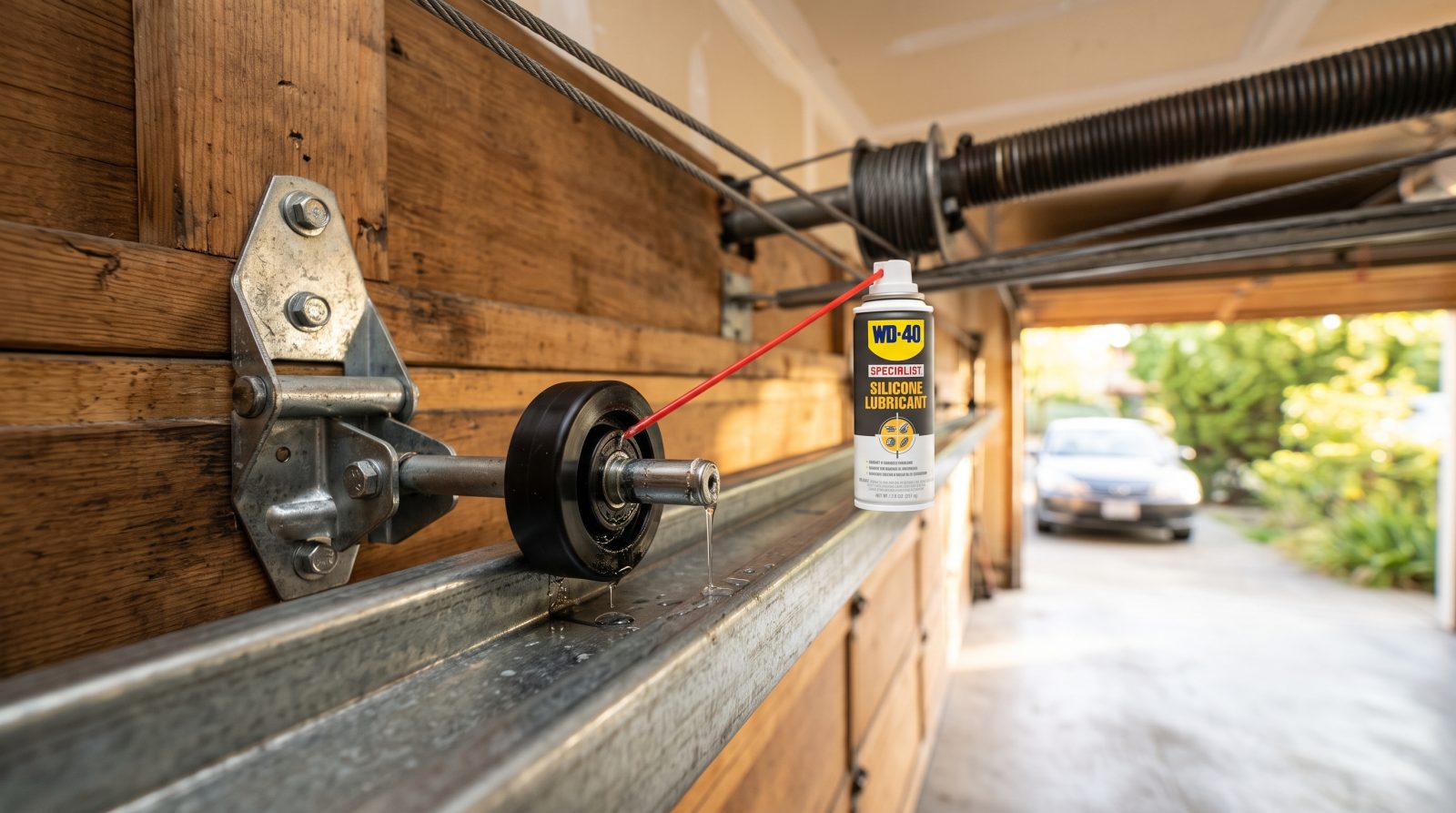
- Hinges and roller bearings lubricated so the door glides instead of grinding
- The opener chain or screw drive serviced per the drive type
- Bearings and bushings addressed where the door pivots and rolls
- Tracks cleaned rather than over-lubricated, since tracks guide rollers and should stay relatively dry
- Weather seal and bottom astragal inspected for cracking from sun and salt exposure
Balance and Spring Tension: The Heart of a Healthy Door
If there is one thing that separates a long-lived garage door from one that fails early, it is balance. A balanced door is held almost entirely by its springs, not by the opener motor. When the springs lose tension or fall out of adjustment, the opener has to drag the door's full weight, straining the motor, gears, and drive system until something gives out.
We test balance by disconnecting the opener and moving the door by hand. A properly balanced door should lift smoothly, stay put when stopped roughly halfway, and not slam down or fly up. If it drops or rises on its own, the spring tension needs adjustment. Because torsion springs store enormous force, this is genuinely dangerous to adjust without the right tools and training, which is exactly the kind of work we are equipped to handle safely on site.
- Hands-on balance test with the opener disconnected to isolate the springs
- Spring tension assessment to ensure the door does the work, not the motor
- Identification of springs nearing the end of their cycle life before they snap
- Confirmation that both sides of a two-spring system are sharing the load evenly
- Adjustment that protects your opener from the strain of an unbalanced door
Safety Testing You Should Never Skip
A garage door tune-up is also a safety inspection. Modern openers include systems specifically designed to prevent injury and entrapment, and these systems can quietly drift out of adjustment or stop working without obvious symptoms. Testing them is quick, but the consequences of an untested door are serious, especially in homes with children or pets.
We verify the photo-eye sensors near the floor that reverse the door when something crosses the beam, and we test the auto-reverse force setting by checking that the door reverses on contact with an obstruction. We also inspect the manual release so you can operate the door by hand during a power outage, a feature many homeowners have never tested until they are stuck. Catching a misaligned sensor or an over-aggressive force setting during a routine visit is far better than discovering it the hard way.
- Photo-eye sensor alignment and function test for the floor-level safety beam
- Auto-reverse test confirming the door backs off when it meets an obstruction
- Force and travel limit checks so the door does not slam or fail to close fully
- Manual release inspection for safe operation during a power outage
- Cable and bracket inspection for the high-tension parts that pose the greatest risk
- A clear walkthrough of any safety concern we find, with honest options
How Often to Schedule a Tune-Up, and the Warning Signs
For most San Diego homes, an annual tune-up is the right rhythm. Doors that cycle many times a day, busy households, multi-car garages, or homes where the garage doubles as a main entrance, benefit from service more often. Coastal properties exposed to constant salt air also tend to need a closer eye on corrosion than inland homes.
Beyond the calendar, your door will usually tell you when it needs attention. Listening and watching for the signs below can help you book service before a minor issue becomes a no-go-to-work morning. Because we are mobile, scheduling is simple: we come to your home, perform the full tune-up in your driveway, and you do not have to load anything into a shop or wait days for a part run.
- Grinding, squealing, or rattling noises during operation
- The door moving unevenly, jerking, or hesitating partway
- Sagging on one side or visible gaps when closed
- The opener straining or struggling to lift the door
- A door that will not stay put when stopped halfway by hand
- Visible rust, fraying cables, or gaps in the spring coils
- It has simply been more than a year since the last professional service