Lifespan at a glance: doors, openers, and springs
The single most useful thing to understand is that the door panel itself almost always outlives the moving parts that operate it. The components that fail first are the ones doing the actual work hundreds of times a month: springs, rollers, cables, and the opener's internal mechanism. Knowing the typical range for each part lets you budget realistically and avoid being surprised when one piece wears out years before the rest.
These are industry lifespan ranges, not guarantees. Real-world results swing widely based on usage, maintenance, build quality, and environment, all of which we cover in the sections below. A door cycled six times a day for a busy family will age faster than one opened twice a day, and a unit a few blocks from the ocean in Ocean Beach or Pacific Beach faces corrosion pressures a home in inland Santee or El Cajon simply doesn't.
- Garage door (the panels/slab): roughly 15 to 30 years, often longer for quality steel or wood if hardware is maintained
- Garage door opener (the motor unit): roughly 10 to 15 years before the electronics, drive, or logic board become unreliable
- Torsion springs: rated by cycles, commonly around 10,000 cycles, which is roughly 7 to 12 years of typical use
- Extension springs: similar cycle-based life, often replaced on a comparable timeline to torsion springs
- Rollers: roughly 5 to 15 years depending on whether they are plastic, steel, or sealed nylon bearings
- Cables, hinges, and small hardware: variable, but inspect-worthy every few years and often the cheapest things to replace before they cause bigger damage
Why San Diego's climate changes the math
Most lifespan charts assume a generic climate. San Diego is not generic. Two local realities meaningfully affect how long your garage door and its parts last, and both push in opposite directions for different components.
First, salt air. If you live near the coast in neighborhoods like La Jolla, Point Loma, Coronado, Ocean Beach, Pacific Beach, or Imperial Beach, salt-laden marine air accelerates corrosion on springs, cables, hinges, fasteners, and the steel rollers and tracks. Metal that might last 12 years inland can show rust pitting and weakening years sooner near the water. This is the number one reason coastal homeowners see premature spring and cable failure.
Second, sun and heat. San Diego's strong, consistent sunshine is hard on the finish and seals of a door, especially on south- and west-facing garages and inland areas like El Cajon, Santee, and Poway that run hotter than the coast. UV exposure fades and chalks paint, dries out and cracks the bottom weather seal, and can warp lower-grade or non-insulated panels over time. The good news: the panel structure on a well-built door often survives this just fine, so sun damage is frequently a refinish-and-reseal issue rather than a full replacement.
The practical takeaway is that location within the county matters. We come to you across San Diego, so when we inspect a coastal home we're looking hardest at corrosion on the moving metal, and at an inland home we're paying extra attention to heat-related seal and finish wear.
- Coastal homes (La Jolla, Point Loma, Coronado, OB, PB): watch springs, cables, rollers, and hardware for rust and early failure
- Inland/hotter areas (El Cajon, Santee, Poway): watch finish fade, brittle weather seals, and panel warping on sun-facing doors
- Salt + humidity is the main lifespan-shortener for the working parts; sun is the main one for the door's surface and seals
- A simple yearly wipe-down and lubrication routine offsets a surprising amount of coastal corrosion
Springs: the part most likely to fail first
If something on your garage door is going to break, statistically it's a spring. Springs counterbalance the full weight of the door, so they are under enormous tension every single cycle. They are rated in cycles rather than years: a common torsion spring is rated around 10,000 cycles, where one cycle is one full open-and-close. A household that opens the door four times a day burns through roughly 1,460 cycles a year, which works out to about seven years of life from a 10,000-cycle spring. Use it more, or buy a lower-cycle spring, and that window shrinks.
Coastal corrosion compounds this. Rust forms in the gaps between coils, creating stress points where the metal eventually fractures, often with a loud bang. A broken spring is the most common reason San Diego homeowners suddenly can't lift their door or hear the opener straining against a load it was never meant to carry alone.
Springs are a safety-critical, high-tension repair and not a recommended DIY job. The upside is that replacing them is one of the most cost-effective ways to get years of reliable life back from an otherwise good door. When we replace a spring, we'll often recommend matching the spring rating to your actual usage and, for coastal homes, talking through higher-cycle or coated options that resist salt-air corrosion longer.
- Springs are cycle-rated, not time-rated; usage frequency is the biggest factor in their real lifespan
- Telltale signs: a loud bang, a door that won't lift or feels extremely heavy, a visible gap in the coil, or the opener struggling
- Replace springs in pairs when possible; if one has reached the end of its life, the other is usually close behind
- High-tension springs are dangerous to service without proper tools and training; this is a job to leave to a technician
- Higher-cycle and corrosion-resistant springs are worth discussing for coastal homes and heavy-use families
Openers and rollers: the supporting cast that wears out
The opener is the motorized unit on your ceiling, and it typically lasts 10 to 15 years. What usually fails isn't the raw motor so much as the electronics: the logic board, the safety sensors, the remote receiver, or the drive mechanism (chain, belt, or screw). Older openers also lag behind modern safety and convenience standards, including the photo-eye sensors that reverse the door when something is in the way and the rolling-code security that prevents code theft. If your opener predates those features, age alone can be a reason to upgrade.
Rollers are the small wheels that guide the door along the track, and they're an underrated wear item. Cheap plastic rollers can start to crack and seize in as little as five years, getting noisy and jerky along the way. Sealed steel or nylon rollers with bearings run far quieter and can last well over a decade. Worn rollers don't just make noise; they put extra strain on the opener and tracks, quietly shortening the life of more expensive parts.
Cables, hinges, and the bottom weather seal round out the list. Cables work alongside the springs and should be inspected for fraying, especially on coastal homes where rust attacks the strands. Hinges loosen and wear over years of cycling. The weather seal at the bottom of the door is the cheapest part on the whole system and, in San Diego's sun, often the first thing to dry out, crack, and let in water, dust, and pests.
- Opener motor units: plan for roughly 10 to 15 years; failing electronics and outdated safety features often drive replacement
- Modern openers add photo-eye reversal, rolling-code security, and quiet belt drives worth upgrading to
- Rollers: upgrade from plastic to sealed nylon/steel for quieter operation and longer life; worn rollers strain everything else
- Cables: inspect for fraying and rust, particularly near the coast; a frayed cable is a safety issue, not a wait-and-see one
- Weather seals are inexpensive and easy to replace, and doing so protects your garage from sun, water, and pests
Repair or replace? How to decide
Most of the time, the right answer is repair. A garage door is a system of replaceable parts, and swapping a spring, a set of rollers, a cable, or even the opener is far less expensive than replacing the whole door. If your panels are structurally sound and you simply have a worn working part, fixing that part is almost always the smart move and gives you years more service.
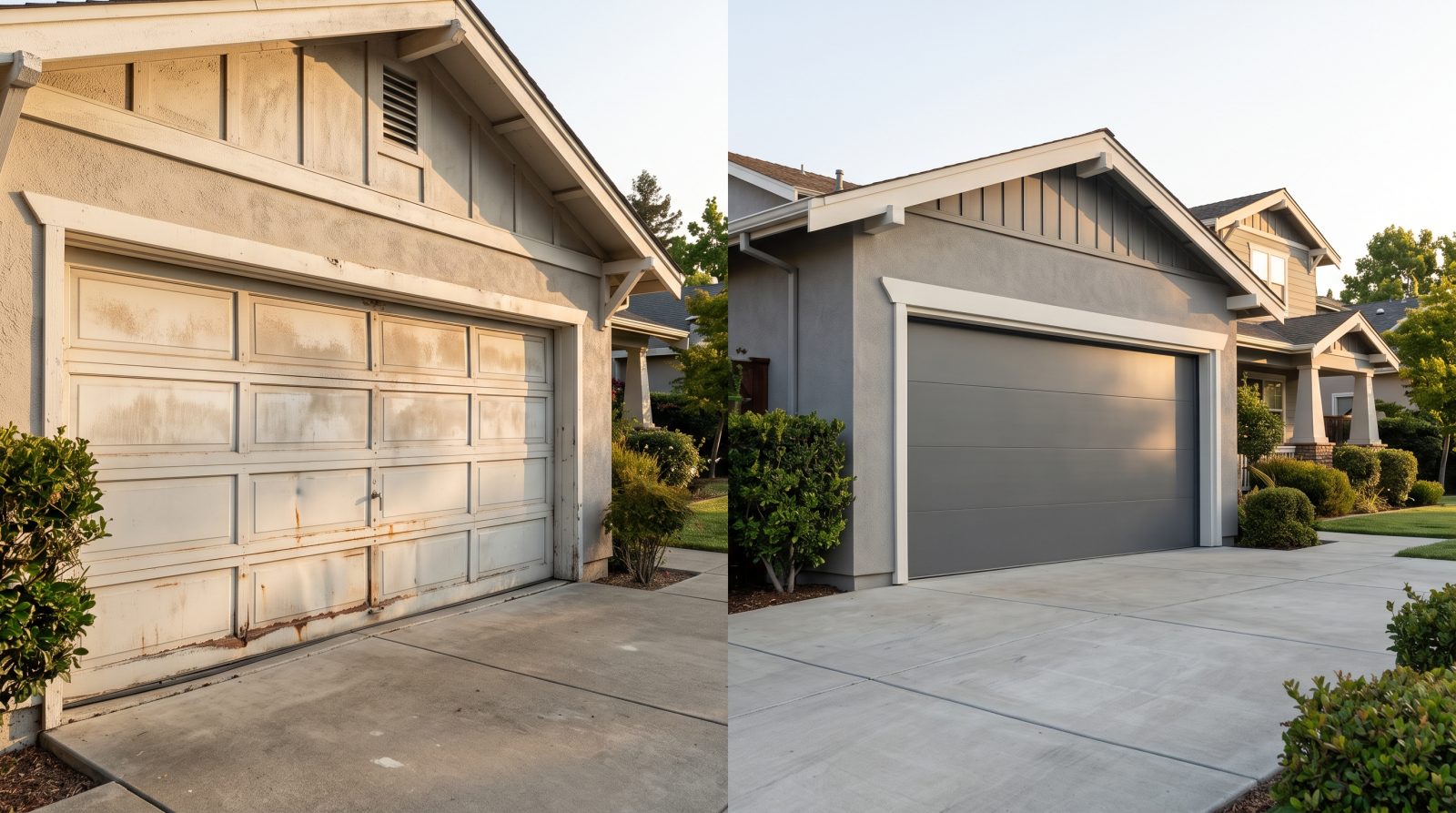
Replacement starts to make sense when the door itself is compromised: cracked, warped, or rusted-through panels, a section damaged by impact, repeated failures across multiple components in a short span, or a door so old that parts are hard to source. It's also worth considering when an aging, non-insulated door is costing you in a hot inland garage, or when you simply want the security, quiet, and curb appeal of a modern unit. A door is one of the largest exterior surfaces of your home, so a replacement is also a meaningful upgrade to how the house looks and seals.
Because we're mobile, our approach is to come to your home, inspect the actual condition of every component, and give you a straight read on whether a targeted repair will get you where you want to be or whether replacement is genuinely the better value. There's no storefront to visit and no pressure; the goal is an honest diagnosis at your driveway. Costs for parts and labor vary with the component, door size, and materials, so any figures you see online are general industry ranges rather than a quote for your specific door.
A reasonable rule of thumb: if the repair costs a fraction of a new door and the panels are healthy, repair. If you're facing multiple major failures at once on a door near the end of its expected life, get a side-by-side comparison before spending on piecemeal fixes.
- Lean toward repair when the panels are sound and only working parts (springs, rollers, cables, opener) are worn
- Lean toward replacement for cracked/warped/rusted panels, impact damage, or repeated failures on an old door
- Insulation and a modern seal can be worth it for hot inland garages used as workshops or living space
- Published prices are industry ranges; an in-person look at your door is the only way to know what yours needs
- Ask for a clear repair-vs-replace comparison before committing to a string of individual fixes on an aging door
How to make your garage door last longer
Lifespan isn't fixed. The difference between a door that fails early and one that comfortably beats its expected life is mostly maintenance, and maintenance in San Diego specifically means staying ahead of salt and sun. None of this is complicated, and most of it takes a few minutes a couple of times a year.
The highest-value habit is lubrication. Keeping springs, hinges, rollers, and the opener's drive properly lubricated reduces friction and, critically, slows corrosion on the metal parts that coastal air attacks. Pair that with a periodic visual check for rust, fraying cables, and loose hardware, and you'll catch small problems while they're still cheap fixes rather than after-hours emergencies. A simple yearly tune-up, whether you do the basics yourself or have us do a full safety check, is the cheapest insurance there is for a garage door system.
- Lubricate springs, hinges, and rollers a couple of times a year; do it more often near the coast to fight salt corrosion
- Wipe down and rinse hardware on coastal homes to remove salt buildup before it pits the metal
- Replace the bottom weather seal when it cracks to protect against sun, water, and pests
- Test the auto-reverse safety feature periodically and keep the photo-eye sensors clean and aligned
- Don't ignore new noises, jerky movement, or a door that feels heavier than usual; early attention prevents bigger failures
- Schedule a yearly inspection or tune-up to catch wear before it becomes a breakdown