What a Proper Opener Installation Actually Involves
A garage door opener doesn't lift your door, the springs do. The opener only guides and holds it. That single fact is why a good installation starts with the door, not the motor. Before anything gets bolted to your ceiling, the door has to be balanced: lifted halfway by hand, it should hover instead of slamming down or flying up. If the springs are tired or mismatched, even a brand-new opener will strain, trip its safety reverse, or burn out early. Our mobile technicians check that balance at your home first, because installing a powerful motor onto an unbalanced door just hides a problem you'll pay for later.
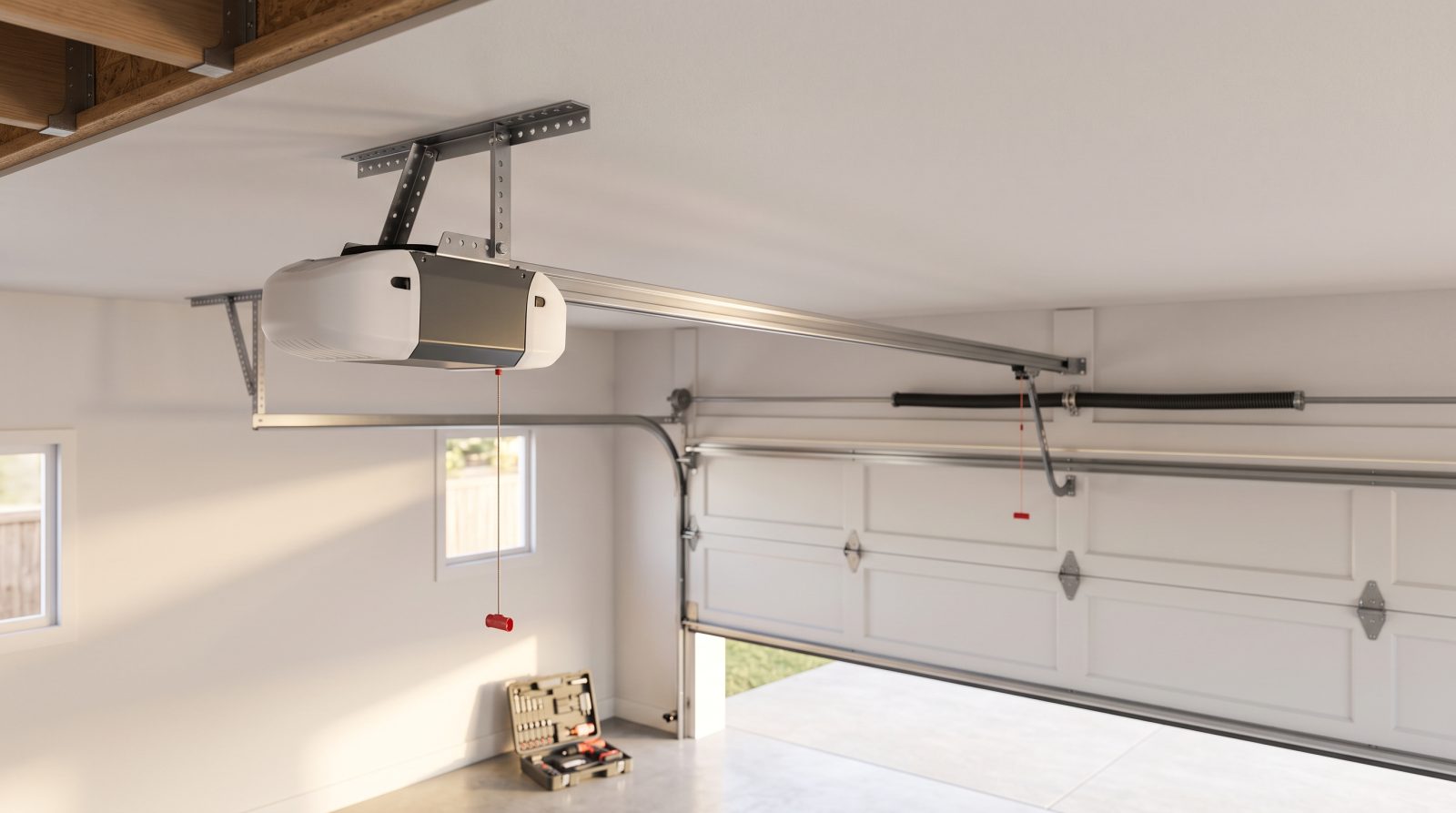
From there, a real install is a sequence, not a single bolt. The rail is assembled and squared to the door's centerline, the motor head is hung from solid framing with proper bracing instead of flimsy perforated strap, the trolley and door arm are set, and travel limits are programmed so the door seats fully on the floor and opens without jamming the rollers at the top. Force settings are tuned so the door reverses if it meets resistance, and the photo-eye safety sensors near the floor are aligned and tested. We finish by cycling the door multiple times, checking the auto-reverse on both contact and the beam, and showing you how the wall console, remotes, and keypad work before we leave.
- Door-balance and spring check before the motor goes up, so the opener isn't fighting a heavy door
- Secure mounting to real framing with proper rail alignment to the door center
- Travel limits and force programmed so the door closes fully and reverses on resistance
- Photo-eye safety sensors aligned and auto-reverse tested on both contact and beam
- Old opener and packaging hauled away, plus a hands-on walkthrough of every control
Chain vs. Belt vs. Screw: Choosing the Right Drive
Almost every opener decision comes down to the drive type, the mechanism that moves the trolley along the rail. There's no single best one; the right pick depends on your garage layout, how close it sits to bedrooms, and how often the door runs. Here's the honest breakdown we give customers at the curb.
Chain drives use a metal chain, like a bicycle chain, to pull the trolley. They're the workhorse: durable, strong enough for heavy doors, and the most budget-friendly option. The trade-off is noise and a bit of vibration. For a detached garage, or one under a garage rather than under a bedroom, a chain drive is often the smart, economical choice. Belt drives swap the chain for a reinforced rubber belt. They run noticeably quieter and smoother, which is why they're the go-to for attached San Diego garages with living space directly above or beside them, common in the newer two-story homes in places like 4S Ranch, Carmel Valley, and Eastlake. They cost a little more than a chain but buy you a lot of peace and quiet.
Screw drives move the trolley along a threaded steel rod, with fewer moving parts than a chain. They can be fast and low-maintenance, and they sit in the middle on noise. Older screw-drive designs disliked big temperature swings, but San Diego's mild, stable coastal climate is actually friendly to them; the bigger consideration is matching the model to your door's weight. For most homeowners the practical choice is chain when budget leads, belt when quiet leads. We'll size whichever you pick to your door so you're not over- or under-powered.
- Chain drive: toughest and most affordable, but the loudest, best for detached or non-living-space garages
- Belt drive: quietest and smoothest, ideal for attached garages under or beside bedrooms
- Screw drive: fewer moving parts and low upkeep, a solid middle option in San Diego's mild climate
- Motor strength matters: 1/2 HP class suits most single and standard double doors, heavier or insulated and carriage-style doors often want 3/4 HP or higher
- DC motors with soft start/stop run quieter and gentler than older AC units regardless of drive type
Smart Openers: What's Worth It and What Isn't
Most new openers we install today are smart-ready, meaning they connect to your home Wi-Fi and pair with a phone app. The genuinely useful part is real: you get a phone alert if the door is left open, you can close it from work or the airport, and you can grant a one-time opening to a house cleaner or a delivery without handing out a remote. For San Diego households juggling beach trips and long commutes, that 'did I close the garage?' check from the freeway is the feature people actually use every week.
A few practical notes keep expectations honest. Smart openers need a reliable Wi-Fi signal reaching the garage; detached garages and older homes with thick walls sometimes need the router moved or an extender, and we'll flag that during the install rather than after. Battery backup is a separate, very worthwhile add-on in our area: when the power drops, a backup battery lets the door still open and close so you're never stranded outside or boxed in, which matters during any grid hiccup. We'll also set up the app, connect it to your network, and walk you through alerts and shared access before we pack up.
What isn't worth overbuying is features you won't touch. Built-in cameras, multiple proprietary hubs, and premium tiers can be great, but plenty of homeowners are happiest with a quiet belt or solid chain drive, a reliable app, and a battery backup. We'll lay out the options in plain terms and let the way you actually use your garage decide, not a spec sheet.
- Real benefits: open-door alerts, remote close from your phone, and one-time access for deliveries or guests
- Wi-Fi reach to the garage is the make-or-break factor, especially for detached garages, we check it on site
- Battery backup is a high-value add-on so the door still works during a power outage
- App setup, network pairing, and shared-access walkthrough included so it works before we leave
- We'll steer you away from features you won't use rather than upselling a tier you don't need
New Install vs. Replacing an Old Opener
Replacing a failing opener is the most common job we handle. Maybe the motor hums but won't lift, the gear is stripped, the remotes are unreliable, or the unit is simply 15-plus years old and lacks modern safety reversal and rolling-code security. In a replacement, the door, tracks, and springs usually stay; we remove the old head and rail, install the new system, and reuse what's still good. Because the door is already hung and balanced, replacements tend to be the quicker, cleaner visit, though we still re-check balance so the new motor starts life on a healthy door.
A brand-new installation, putting an opener on a door that has only ever been operated by hand, is a bit more involved. The door needs a reinforcement bracket at the top section so the opener arm doesn't bend a thin panel, the ceiling framing has to support the motor, and a grounded outlet should be within reach of the unit. We bring the rail, bracing, sensors, and hardware, and if your manual door's springs aren't set up for powered operation we'll tell you before we start rather than mid-install.
Either way, the visit is mobile and contained to your property. We carry common belt, chain, and screw-drive units and the brackets, sensors, and remotes to finish in one trip for typical doors, so most homeowners go from an old or opener-less door to a smooth, programmed, app-ready system the same day.
- Replacement: old head and rail out, new system in, existing door and springs reused after a balance check
- New install: adds a reinforcement bracket, secure framing, and a nearby grounded outlet
- We confirm springs and door are rated for powered operation before committing to a new install
- Stocked with common belt, chain, and screw-drive units to finish typical doors in one mobile visit
- Old equipment removed and recycled, and your remotes, keypad, and app left fully programmed
Mobile Opener Installation Across San Diego County
Because we're a mobile service with no storefront to drive to, the whole job happens in your driveway on your schedule. We cover the city core and the neighborhoods around it, the coastal stretch from Pacific Beach and La Jolla down through Point Loma and Ocean Beach, inland communities like Mira Mesa, Tierrasanta, Santee, and El Cajon, the South Bay in Chula Vista, National City, and Eastlake, and the North County homes in Carmel Valley, 4S Ranch, Poway, and beyond. Wherever you are, the truck comes stocked to size and install the opener at your home.
San Diego's housing mix shapes a lot of these jobs. Plenty of attached two-story homes put bedrooms right over the garage, which is exactly where a quiet belt drive earns its keep. Older homes in neighborhoods like North Park, Kensington, and parts of La Mesa often have detached garages or aging openers without modern safety sensors, where a replacement is as much a safety upgrade as a convenience one. The salt air near the coast is also harder on hardware over time, so we keep an eye on corrosion at the brackets and rail when we're matching a new unit to your setup.
Pricing on opener installation lands in industry ranges that depend on the drive type, motor strength, smart features, battery backup, and whether it's a straightforward replacement or a first-time install with new bracing. Rather than guess, we look at your actual door and give you a clear figure before any work starts. Call or request a free quote and we'll get a mobile technician out to handle it.
- Fully mobile: every install done at your home, no storefront visit needed
- Coverage from the coast to inland and South Bay to North County across San Diego
- Local realities handled: bedrooms-over-garage layouts, older detached garages, and coastal-air corrosion
- Costs quoted as clear, on-site figures within standard industry ranges, never blind estimates
- Same-day installation available for most common doors and opener types