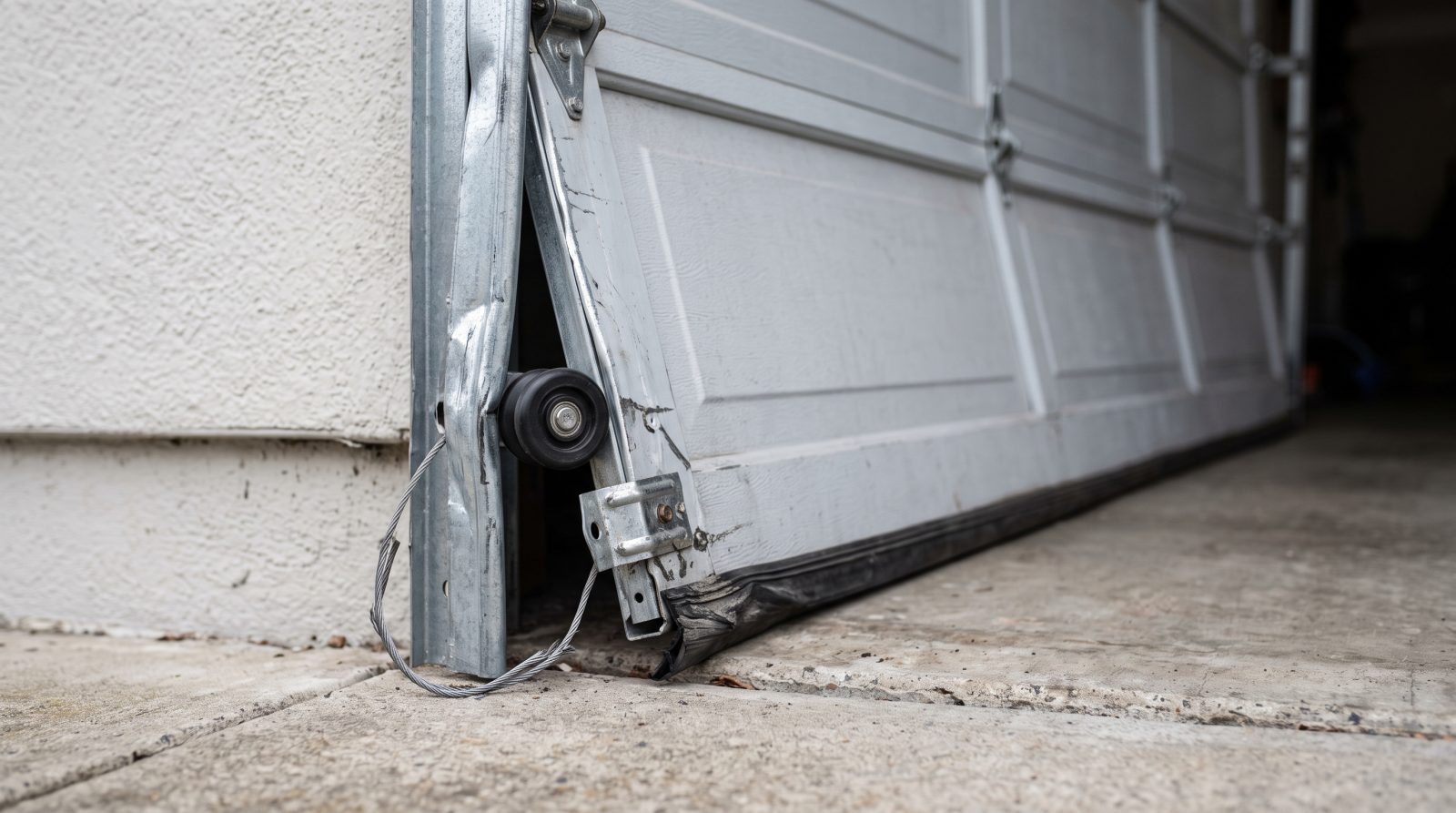
What "off-track" actually means
Your garage door does not simply hang in the opening. The panels are guided up and over your head by two vertical and horizontal steel tracks bolted to the framing, with small wheels called rollers riding inside those tracks. When people say a door is "off its tracks," they mean one or more of those rollers has popped out of the channel, so the door is no longer captured by the rail on at least one side. The result is a door that sags, tilts, binds against the frame, or refuses to move evenly.
It is worth being precise about this, because an off-track door is a mechanical alignment failure, not just a cosmetic one. The whole system, including the springs, cables, and opener, is engineered to move a balanced door in a straight, predictable path. The moment a roller leaves the track, that balance and that path are broken, and every other component starts taking load it was never meant to carry. That is why a problem that started as one roller slipping out can quickly cascade into bent track, kinked panels, and a snapped cable if the door keeps being operated.
- A roller jumping out of the vertical or horizontal track on one or both sides
- A door that hangs at a visible angle or sags lower on one end
- Panels rubbing, scraping, or jamming against the door frame
- The door stopping partway and refusing to travel evenly up or down
- A loud bang or grinding noise right before the door went crooked
Why garage doors come off their tracks in San Diego
Most off-track failures trace back to a handful of root causes, and several of them are more common here than people expect. The single biggest culprit nationwide is a vehicle bumping the door, and in San Diego's tight older garages, sloped driveways in hillside neighborhoods like Mission Hills, La Mesa, and parts of La Jolla, and shared alley garages downtown, a low-speed nudge from a bumper is a very real way a door ends up off its rail. Even a light tap can knock a roller out and tweak the track enough to derail the whole side.
Wear and hardware fatigue is the other major driver. Rollers are wear parts: the nylon or steel wheels and their stems degrade over years of cycling, and a worn or seized roller is far more likely to hop out of the channel. Loose or stripped track-mounting brackets let the rail flex away from the framing, widening the gap a roller needs to stay seated. Broken or frayed lift cables let one side of the door drop suddenly, which yanks rollers free in an instant. San Diego's mild, salt-tinged coastal air near the beaches and bays also encourages slow corrosion on hardware and cable ends over time, and a corroded cable or a rusted roller stem fails sooner than an inland one would.
Finally, obstructions and operator force play a role. A misaligned safety sensor, debris in the track, or a door pushed against something in its path can cause the opener to keep pulling against resistance until something gives and a roller jumps. Doors that have never been lubricated or serviced are especially vulnerable, because dry, gritty tracks add friction that compounds every other weakness.
- Vehicle contact, even a slow bump, in narrow or sloped San Diego garages
- Worn, cracked, or seized rollers that no longer ride cleanly in the track
- Loose, bent, or pulled-away track brackets that let the rail flex
- A broken or frayed lift cable letting one side of the door drop
- Coastal-air corrosion on cables, roller stems, and hardware over the years
- Obstructions, debris, or sensor misalignment forcing the door against resistance
Why you should never force an off-track door
When a door is hanging crooked, the instinct is to grab it and shove it back into line, or to keep hitting the opener button until it cooperates. Please do not. An off-track garage door is under tension and out of balance, which is exactly the combination that causes sudden, hard-to-predict movement. A door that is being held up partly by a jammed roller can release without warning, and a residential door's weight is nothing to absorb with your hands, fingers, or feet.
The springs and cables are the most dangerous part of the equation. Torsion and extension springs store an enormous amount of energy to counterbalance the door's weight, and the cables transmit that force. Prying, levering, or yanking on a derailed door can cause a loaded cable to slip off its drum or a spring to let go, and either can move metal at high speed. This is the part of garage door work that sends people to the emergency room, and it is precisely why this repair belongs in trained hands rather than a how-to attempt with a screwdriver.
There is also a practical, cost-of-repair reason. Forcing the door almost always turns a small fix into a large one. Running the opener against a stuck door strips opener gears or burns out the motor. Levering a panel bends the track or creases the panel itself, and a kinked steel track or a cracked panel section is far more expensive to address than simply reseating rollers and tightening hardware would have been. The safest and cheapest move the moment you see a door off its track is to stop using it, disconnect the opener if you can do so safely from the floor, keep people and cars clear, and request a technician.
- Out-of-balance doors can drop or lurch suddenly and cause serious injury
- Loaded springs and cables can release violently if the door is pried or yanked
- Running the opener against a jammed door strips gears or burns out the motor
- Forcing panels bends the track and creases panels, multiplying the repair cost
- Stop using the door, keep cars and people clear, and call for a quote instead
How our mobile technicians put a door back on track
Because San Diego Garage Door is mobile, there is nothing for you to haul or drop off. Our technician arrives at your home, takes the time to look at the whole system, and works through the repair on-site in your driveway or garage. The first step is always to secure the door and relieve the situation safely, including releasing the opener and supporting the door so nothing shifts while we work. We will not rush a derailed door back into the rail before it is safe to do so.
From there we diagnose the actual cause rather than just popping the roller back in. We inspect the rollers, the track for bends and high spots, the mounting brackets, the lift cables, and the spring balance, because reseating a roller without fixing what knocked it out only buys you a few days. If a roller is worn, we replace it. If a bracket has loosened or a track is bent within a repairable range, we realign and re-secure it. If cables are frayed or off the drum, those are addressed before the door is cycled again.
Once the door is back in its track, we test it through a full open-and-close cycle, check that it is balanced and travels evenly, confirm the opener's force and safety reversal behave correctly, and lubricate the moving parts so the system runs quietly. We will always tell you honestly what we found and what your options are, including when a bent track or a cracked panel means a part should be replaced rather than coaxed along. You will know the situation in plain language before any work is locked in, and you can request a free quote before we begin.
- Fully mobile, we-come-to-you service across the San Diego area, with same-day availability
- We secure and support the door first, before anything is moved
- Root-cause diagnosis of rollers, track, brackets, cables, and spring balance
- Reseat and realign the door, replacing worn rollers or hardware as needed
- Full-cycle test, balance check, opener safety check, and lubrication
- A clear, honest explanation and a free quote before work begins
What it costs and when to act
Off-track repair pricing varies because no two failures are identical. A door that simply slipped one roller and needs realignment sits at the lighter end of the range, while a job involving a bent track section, multiple replacement rollers, new cables, or a damaged panel costs more because of the parts and labor involved. As a general industry guide, a straightforward reseat-and-realign is typically a modest service-call-level cost, while repairs that require replacing track, cables, or panels climb from there depending on the door's size and hardware. These are industry ranges to set expectations, not a quote; the only accurate number is the one a technician gives you after seeing the door.
Timing matters more than most people realize. An off-track door tends to get worse, not better, with every attempt to use it, and the difference between a same-day call and a week of forcing it can be the difference between a quick realignment and a multi-part replacement. If your door is crooked, sagging, or jammed, the most cost-effective thing you can do is stop operating it and get it looked at promptly while the damage is still contained.
- Light realignment with a roller reseat: lower end of the off-track range
- Multiple worn rollers plus loose brackets: mid-range, more labor and parts
- Bent track, cable replacement, or a damaged panel: higher end, parts-driven
- All figures are industry ranges to set expectations, not a quote
- Acting same-day usually keeps a small derailment from becoming a big repair